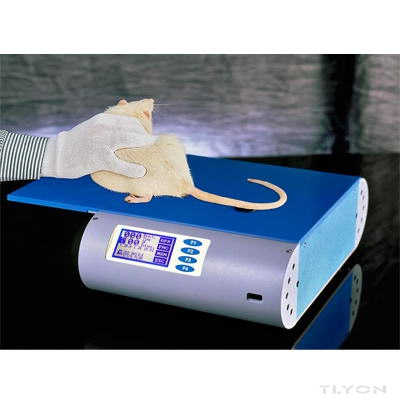
37360 - 疼痛甩尾
疼痛甩尾主要是用于测量大、小鼠尾巴部受红外热刺激的痛觉阈值。实验时,当动物感觉疼痛,尾巴会轻敲台面,内置传感器会立刻检测到,停止计时和关闭光源,即仪器自动记录反应时间和光源强度。数据可通过U盘、USB数据线等导出。
该仪器中有一可调强度的红外光源,其红外光主要是通过一抛物面反射镜聚焦在实验动物的尾巴上。实验时,操作人员将实验动物置于仪器上,把动物的尾巴放在红外光源处,接受刺激。
该仪器也可以在小鼠上进行实验,有小鼠设备配件可供选择。
延迟时间和强度能够通过USB或者串行端口导出。USB和软件都包含在内。
|
特征
|
优点
|
|
仪器自动记录实验数据
|
精度高,避免人为因素引起的误差
|
|
包含U盘和软件
|
可独立工作,也可连接电脑使用
|
|
仪器工作台表面无突出和遮挡物件
|
操作方便,实验重复性好
|
规格:
|
命令:
|
软键和脚踏板
|
|
连接电脑:
|
DELTA 9-pin连接头,USB连线
|
|
数据读取:
|
液晶显示
|
|
电源:
|
universal mains 85-264 VAC, 50-60Hz
|
|
打印:
|
微型热敏打印机(需另外购买)
|
|
工作温度:
|
15° - 30° C
|
|
开始:
|
红外开关
|
|
声级:
|
< 70 dB
|
|
红外强度:
|
10-99级间可调
|
|
红外光源灯泡;
|
Halogen "Bellaphot", Mod. 64607 OSRAM, 8V-50W
|
|
反应时间:
|
液晶屏显示,分辨率为0.1s
|
|
校准:
|
红外热辐射计(需另外购买)
|
|
截止时间:
|
预置,15 - 60 s间
|
|
|
|
附件:
|
37360-325:
|
小鼠束缚器,25 mm I.D.
|
|
37360-330:
E-HR 002:
|
小鼠束缚器,30 mm I.D.
替换灯泡
|
|
37300
|
红外热辐射计
|
|
57145
|
微型打印机
|
参考文献
方法
- F.E. D’Amour & D.L. Smith: "A Method for Determining Loss of Pain Sensation." J. Pharmacol. Exp. Therap. 72: 74-79, 1941.
涉及UB的甩尾实验
- T.O. Lilius et alia: "The Mineralocorticoid Receptor Antagonist Spironolactone Enhances Morphine Antinociception” Eur. J. of Pain online view, 2013
- J.W. Little et alia: “Spinal Mitochondrial-Derived Peroxynitrite Enhances Neuroimmune Activation During Morphine Hyperalgesia and Antinociceptive Tolerance” Pain 154 (7): 978-986, 2013
- P.J. McLaughlin et alia: “Behavioral Effects of the Novel Potent Cannabinoid CB1 Agonist AM 4054”Pharmacology Biochemistry and Behavior 109: 16-22, 2013
- T.A. Kosten et alia: “A Morphine Conjugate Vaccine Attenuates the Behavioral Effects of Morphine in Rats” Progr. in Neuro-Psychopharmacol. and Biol. Psychiatry 45: 223–229, 2013
- T.C. Chen et alia: “Spontaneous inflammatory Pain Model From a Mouse Line With N-ethyl-N-nitrosourea Mutagenesis” J. Biomed. Science 19 (55): 2–15, 2012
- J. Walsh et alia: “Disruption of Thermal Nociceptive Behaviour in Mice Mutant for the Schizophrenia-Associated Genes NRG1, COMT and DISC1” Brain Res. 1348: 114-119, 2012
- K. Guillemyn et alia: “In vivo Antinociception of Potent mu Opioid Agonist Tetrapeptide Analogues and Comparison with a Compact Opioid Agonist-neurokin 1 Receptor Antagonist Chimera” Molecular Brain5 (4): 2-11, 2012
- A.J. Morrison et alia: “Design, Synthesis, and Structure–Activity Relationships of indole-3-heterocycles as Agonists of the CB1 Receptor” Bioorganic & Medicinal Chemistry Letters 21: 506-509, 2011
- M. Spetea et alia: “In vitro and in vivo Pharmacological Profile of the 5-benzyl Analogue of 14-methoxymetopon, a Novel μ Opioid Analgesic with Reduced Propensity to Alter Motor Function” Eur. J. Pharmac. Sciences 41: 125-135, 2010
- C.A. Boehm et alia: “Midazolam Enhances the Analgesic Properties of Dexmedetomidine in the Rat”Vet. Anaesthesia and Analgesia 37 (6): 550-556, 2010
- M.A. Philips et alia: “Myg1-Deficient Mice Display Alterations in Stress-Induced Responses and Reduction of Sex-Dependent Behavioural Differences” Behav. Brain Res. 207: 182-195, 2010
- C. Dawson et alia: “ Dexmedetomidine Enhances Analgesic Action of Nitrous Oxide” Anesthesiology 100 (4): 894−904, 2004
- P. Tolu et alia: “ Effects of Long-Term Acetyl-L-carnitine Administation in Rats: I. Increased Dopamine Output in Mesocorticolimbic Areas and Protection Toward Acute Stress Exposure” Neuropsychopharmacol. 27 (3): 410-420, 2002
- R. Nadeson et alia: “ Potentiation by Ketamine of Fentanyl Antinociception. I. An Experimental Study in Rats Showing that Ketamine Administered by Non-Spinal Routes Targets Spinal Cord Antinociceptive Systems” Br. J. Anaesthesia 88 (5): 685−691, 2002
- L. Jasmin et alia: “ The NK1 Receptor mediates Both the Hyperalgesia and the Resistance to Morphine in Mice Lacking Noradrenaline” PNAS 99 (2): 1029−1034, 2002
- G.L. Fraser et alia: “ Antihyperalgesic Effects of Opioid Agonists in a Rat Model of Chronic Inflammation” Br. J. Pharmacol. 129: 1668−1672, 2000
- M. Xu et alia: “ Effects of Radolmidine, a Novel α2- Adrenergic Agonist Compared with Dexmedetomidine in Different Pain Models in the Rat” Anesthesiology 93 (2): 473−481, 2000
- A. Köster et alia: “Targeted Disruption of the Orphanin Fq/Nociceptin Gene Increases Stress Susceptibility and Impairs Stress Adaptation In Mice” Neurobiology 96 (18): 10444-10449, 1999
- I. Sora et alia: “Opiate Receptor Knockout Mice Define µ Receptor Roles in Endogenous Nociceptive Responses and Morphine-Induced Analgesia” Neurobiology 94: 1544-1549, 1997
- C.T. Dourish et alia: "The Selective CCK-B Receptor Antagonist L-365,260 Enhances Morphine Analgesia and Prevents Morphine Tolerance in the Rat" Europ. J. Pharmacol. 176: 35-44, 1990
- P.W. Nance & J. Sawinok: "Substance P-Induced Long-Term Blockade of Spinal Adrenergic Analgesia: Reversal by Morphine and Naloxone" J. Pharmacol. Exp. Therap. Vol. 240, No. 3: 972-977, 1987