 微信公众号


Life cycle assessment of refined sunflower oil production for food industry: Exploring hexane-free alternative using supercritical CO2 for processing pressed cake
Highlights
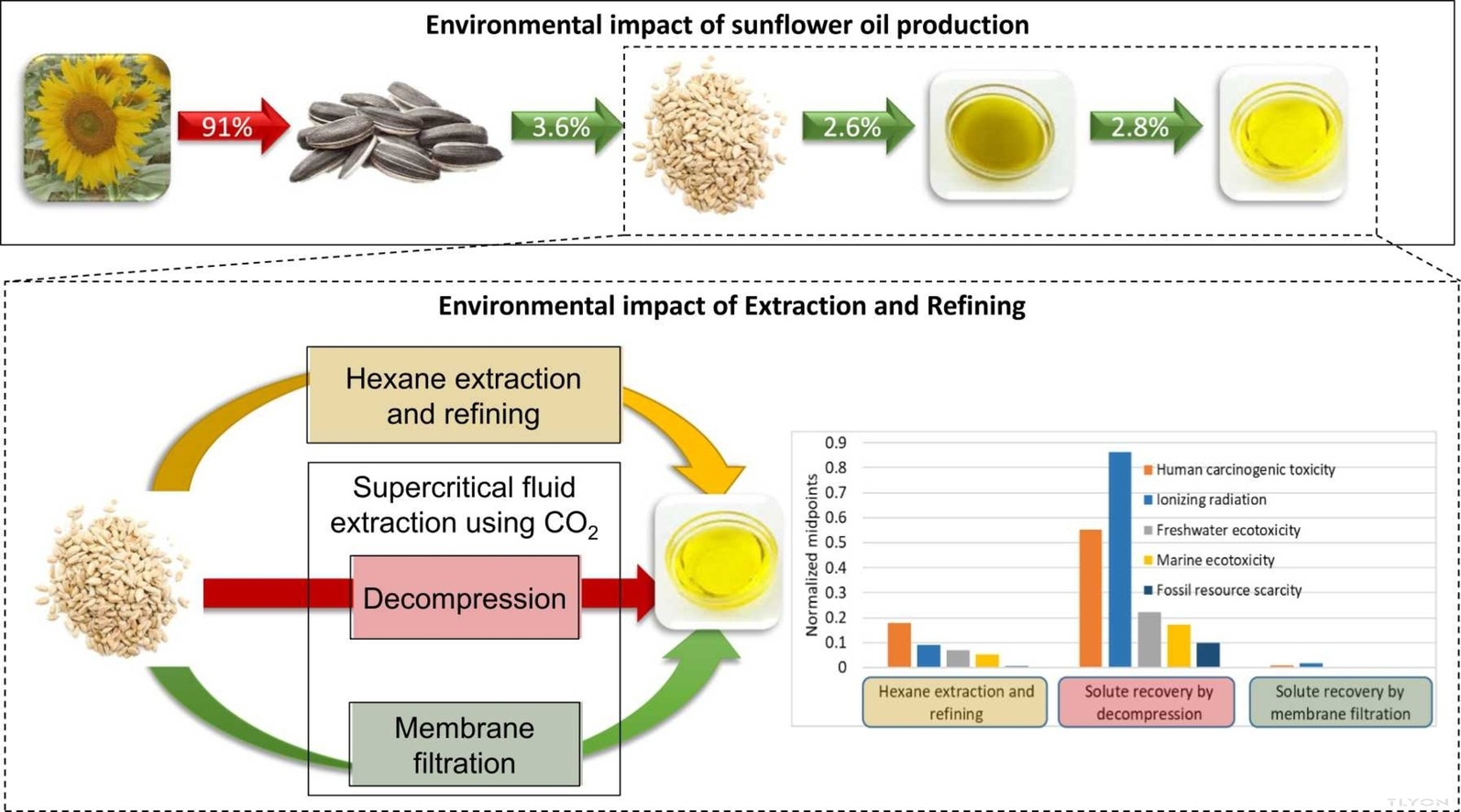
•LCA for sunflower oil production compares hexane and supercritical CO₂ extraction, in conventional mode and using membrane.
•Membrane use cuts CO₂ process emissions significantly.
•Supercritical CO₂ extraction with membrane separation reduces environmental impact by 95 % vs. hexane extraction.
•First LCA study on industrial-scale sunflower oil extraction with CO₂ separation using membranes.
亮点
• 对葵花籽油生产进行生命周期评价(LCA),比较己烷萃取与超临界CO₂萃取,涵盖常规模式和使用膜分离的模式。
• 使用膜分离可显著降低CO₂工艺排放。
• 采用膜分离的超临界CO₂萃取相较己烷萃取可降低环境影响95%。
• 这是首个针对工业规模葵花籽油萃取、并采用膜分离进行CO₂分离的LCA研究。
Abstract
Sunflower oil, valued for its high polyunsaturated fatty acid content and antioxidant properties, is primarily extracted using a two-stage process involving mechanical pre-pressing and hexane extraction. Despite its efficiency, hexane extraction raises significant environmental and health concerns. Supercritical carbon dioxide offers a green alternative with advantages in safety and regulatory compliance. This study conducts a comparative Life Cycle Assessment (LCA) of conventional hexane extraction versus Supercritical Fluid Extraction using carbon dioxide (SFE-CO2), where in the case of SFE-CO2 two methods for regeneration of CO2 after the extraction step are considered: conventional decompression and a novel membrane separation technique. The LCA, performed using the ReCiPe 2016 methodology and SimaPro software, evaluates environmental impacts across 18 midpoint and 3 endpoint categories. The results show that SFE-CO2 with decompression recovery has higher environmental impacts than hexane extraction (due to higher energy consumption) but the use of membrane filtration for CO2 regeneration significantly reduces these impacts. Compared to hexane extraction, SFE-CO2 with regeneration by membrane achieves a 95 % reduction in environmental impact and a 99.3 % reduction compared to conventional CO2 extraction. These results highlight the potential of SFE-CO2 using membrane filtration as a sustainable alternative for industrial sunflower oil production, addressing both environmental and health concerns associated with the use of hexane.
摘要
葵花籽油因富含多不饱和脂肪酸并具有抗氧化特性而受到重视,其主要采用机械预压榨和己烷萃取的两阶段工艺进行提取。尽管己烷萃取效率较高,但会带来显著的环境和健康问题。超临界二氧化碳提供了一种绿色替代方案,在安全性和法规合规性方面具有优势。本研究对传统己烷萃取与超临界流体萃取(SFE-CO₂)进行了对比生命周期评价;在SFE-CO₂中,考虑了萃取步骤后CO₂再生的两种方法:常规减压再生和新型膜分离技术。该LCA采用ReCiPe 2016方法和SimaPro软件,评估了18个中点类别和3个终点类别的环境影响。结果表明,采用减压回收的SFE-CO₂因能耗较高,其环境影响高于己烷萃取;但采用膜过滤进行CO₂再生可显著降低这些影响。与己烷萃取相比,采用膜再生法的SFE-CO₂可实现95%的环境影响降低,相较常规CO₂萃取则降低99.3%。这些结果凸显了采用膜过滤的SFE-CO₂作为工业葵花籽油生产可持续替代方案的潜力,可同时应对与己烷使用相关的环境和健康问题。
Keywords
Supercritical CO2 extraction; Sunflower oil production; Life cycle assessment; Hexane-free process; Green solvent; Membrane separation; Environmental impact reduction
关键词
超临界CO₂萃取;葵花籽油生产;生命周期评价;无己烷工艺;绿色溶剂;膜分离;环境影响降低


