 微信公众号


Integrated evaluation of VOCs pollution from a refuse transfer station: From source emissions to ambient exposure
Hongyu Gong et al. DOI:10.1016/j.jhazmat.2025.140420
Highlights
•VOC levels were highest inside transfer station, lowest in residential areas.
•OVOCs dominated inside station, while nitrogen compounds prevailed off-site.
•Aromatics were the main precursors of secondary pollution inside transfer station.
•Isovaleraldehyde and octanal were key odorants inside transfer stations.
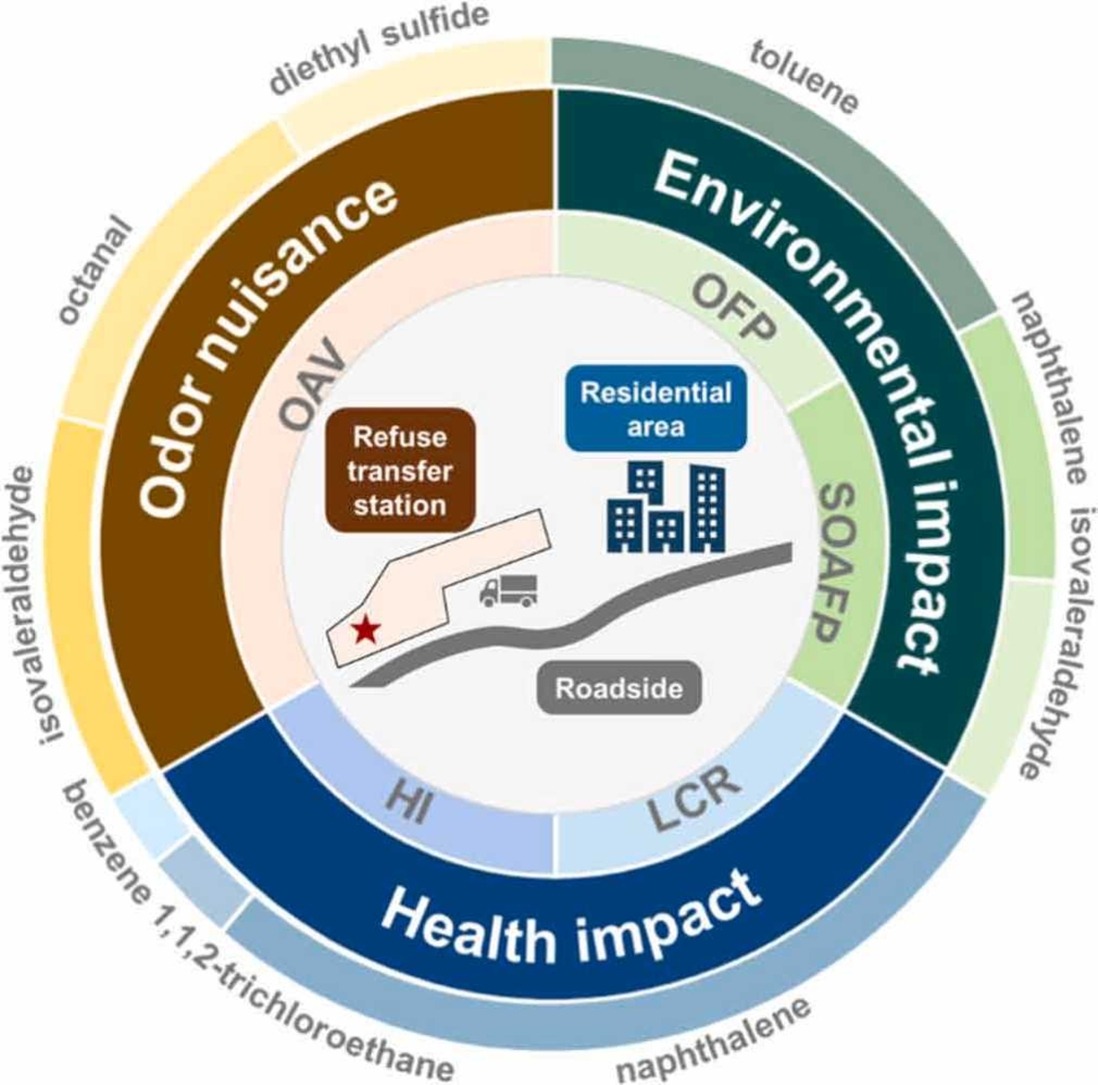
•Naphthalene, toluene, and isovaleraldehyde were identified as priority VOCs.
亮点
• 垃圾转运站内部VOCs水平最高,居民区最低。
• 站内以含氧挥发性有机物(OVOCs)为主,而站外以含氮化合物为主。
• 芳香烃是转运站内二次污染的主要前体物。
• 异戊醛和辛醛是转运站内的关键致臭物质。
• 萘、甲苯和异戊醛被识别为优先控制的VOCs。
Abstract
Volatile organic compounds (VOCs) emitted from refuse transfer stations pose significant risks to air quality, the urban environment and human health. In this study, three field sampling campaigns were conducted across transfer station interiors, boundaries, roadsides, and residential areas to evaluate the impacts of VOC emissions. The highest total VOC concentrations were recorded inside the transfer station (1611─3822 μg/m³), with markedly elevated ozone formation potential (OFP), secondary organic aerosol formation potential (SOAFP), odor impact, and health risks compared to surrounding areas. Oxygenated VOCs (OVOCs) accounted for 58 % of total VOCs and were also the largest contributors to OFP (51.2 %) inside the station. In contrast, nitrogen compounds dominated VOC compositions at off-site locations (37─59 %) and contributed up to 55.9─79.4 % of the OFP at boundary and nearby ambient, likely due to traffic-related emissions. Aromatics, notably toluene and naphthalene, were the primary SOAFP contributors across all sites. In addition, the highest odor activity value (OAV = 1773) was observed inside the station, with isovaleraldehyde (20.8 %) and octanal (19.9 %) as dominant odorants. Health risk assessments indicated that both the station and its boundary areas exceeded tolerable thresholds, with naphthalene, 1,1,2-trichloroethane, and 1,2-dichloroethane as the key hazardous substances. Integrated assessment identified naphthalene, toluene, and isovaleraldehyde as multi-effect priority pollutants, underscoring the urgent need for targeted regulatory measures addressing emissions from refuse transfer stations.
摘要
垃圾转运站排放的挥发性有机物(VOCs)对空气质量、城市环境和人体健康构成显著风险。本研究在转运站内部、边界、路边和居民区开展了三次实地采样,以评估VOCs排放的影响。总VOCs浓度最高值出现在转运站内部(1611─3822 μg/m³),其臭氧生成潜势(OFP)、二次有机气溶胶生成潜势(SOAFP)、气味影响和健康风险均显著高于周边区域。含氧挥发性有机物(OVOCs)占站内总VOCs的58%,同时也是站内OFP的最大贡献者(51.2%)。相比之下,站外点位VOCs组成以含氮化合物为主(37─59%),并在边界和附近环境中对OFP的贡献高达55.9─79.4%,这可能与交通排放有关。芳香烃,尤其是甲苯和萘,是所有点位中SOAFP的主要贡献者。此外,站内观察到最高的气味活性值(OAV = 1773),其中异戊醛(20.8%)和辛醛(19.9%)为主要致臭物质。健康风险评估表明,转运站及其边界区域均超过了可容忍阈值,关键危害物质为萘、1,1,2-三氯乙烷和1,2-二氯乙烷。综合评估将萘、甲苯和异戊醛识别为多效应优先污染物,凸显了针对垃圾转运站排放采取靶向监管措施的紧迫性。
Keywords:Refuse transfer station; Volatile organic compounds; Odor pollution; Secondary transformation potentials; Health risk assessment
关键词:垃圾转运站;挥发性有机物;恶臭污染;二次转化潜势;健康风险评估
