微信公众号


Optimized design and in vivo application of optogenetically functionalized Drosophila dopamine receptors
Fangmin Zhou, Alexandra-Madelaine Tichy, Bibi Nusreen Imambocus, Shreyas Sakharwade, Francisco J. Rodriguez Jimenez, Marco González Martínez, Ishrat Jahan, Margarita Habib, Nina Wilhelmy, Vanessa Burre, Tatjana Lömker, Kathrin Sauter, Charlotte Helfrich-Förster, Jan Pielage, Ilona C. Grunwald Kadow, Harald Janovjak & Peter Soba
Abstract
Neuromodulatory signaling via G protein-coupled receptors (GPCRs) plays a pivotal role in regulating neural network function and animal behavior. The recent development of optogenetic tools to induce G protein-mediated signaling provides the promise of acute and cell type-specific manipulation of neuromodulatory signals. However, designing and deploying optogenetically functionalized GPCRs (optoXRs) with accurate specificity and activity to mimic endogenous signaling in vivo remains challenging. Here we optimize the design of optoXRs by considering evolutionary conserved GPCR-G protein interactions and demonstrate the feasibility of this approach using two Drosophila Dopamine receptors (optoDopRs). These optoDopRs exhibit high signaling specificity and light sensitivity in vitro. In vivo, we show receptor and cell type-specific effects of dopaminergic signaling in various behaviors, including the ability of optoDopRs to rescue the loss of the endogenous receptors. This work demonstrates that optoXRs can enable optical control of neuromodulatory receptor-specific signaling in functional and behavioral studies.
通过G蛋白偶联受体(GPCR)的神经调节信号在调节神经网络功能和动物行为中起着关键作用。诱导G蛋白介导的信号传导的光遗传学工具的最新发展为神经调节信号的急性和细胞类型特异性操纵提供了前景。然而,设计和部署具有准确特异性和活性的光遗传学功能化GPCR(optoXRs)以在体内模拟内源性信号传导仍然具有挑战性。在这里,我们通过考虑进化保守的GPCR-G蛋白相互作用来优化optoXRs的设计,并使用两种果蝇多巴胺受体(optoDopRs)证明了这种方法的可行性。这些光DopRs在体外表现出高的信号特异性和光敏感性。在体内,我们展示了多巴胺能信号在各种行为中的受体和细胞类型特异性作用,包括光多巴胺受体拯救内源性受体损失的能力。这项工作表明,在功能和行为研究中,光XRs可以实现神经调节受体特异性信号的光学控制。
···
Feeding behavior assays in D. melanogaster adults
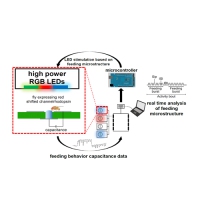
Flies used in the flyPAD were reared and maintained in standard cornmeal food, with the composition described before98 in incubators at 28 °C, 60% humidity and cycles of light/dark of 12 h each. After hatching, male flies of 4–8 days old were collected. Then, 5 µl of 10% sucrose solution containing 1% low gelling temperature agarose were placed in wells of the flyPAD containing electrodes to detect the capacitance change when the flies physically interacted with the food. The flies, following starvation for 24 h in the presence of a wet tissue with 3 ml of water, were transferred to the flyPAD individually using a pump. The experiments were all performed in a climate chamber at 25 °C, at 60% humidity. The recording of each session of flyPAD lasted 60 min, during which the flies could freely interact with the food.
flyPAD中使用的苍蝇在28°C、60%湿度和12个光/暗周期的恒温箱中饲养并保持在标准玉米粉食品中,成分如上所述98 。孵化后,收集4-8天大的雄蝇。然后,将5µl含有1%低胶凝温度琼脂糖的10%蔗糖溶液放置在含有flyPAD的电极的孔中,以检测苍蝇与食物物理相互作用时的电容变化。在含有3ml水的湿组织存在下饥饿24小时后,使用泵将苍蝇单独转移到flyPAD。实验均在25°C、60%湿度的气候室中进行。flyPAD每次会话的录制持续了60 在这段时间里,苍蝇可以自由地与食物互动
For the optoPAD experiments85, flies were reared and maintained in standard cornmeal food as explained above, with supplementation of all-trans-retinal at 0.2 mM concentration, in incubators at 25 °C, 60% humidity and blue light/dark cycles of 12/12 h. The chimeric dopaminergic receptors were activated using 523 nm green light at 3 V, which was automatically activated once the fly started to sip food. All flies were wet starved for 24 h prior to the experiment. The acquisition of the data was done using scripts (https://github.com/ribeiro-lab/optoPAD-software) based on Bonsai, an open-source program. The data analysis was done using Matlab (2022b).