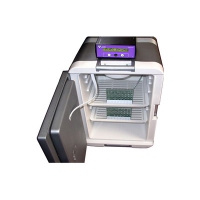
Ribe与他的团队一起开发了optoPAD:一种能够创造“闭环的光遗传学系统研究的电路基础,其方式可以灵活地配合果蝇等昆虫的行为。
创造性
optoPAD结合了两个高科技元素:一个是光遗传学,一种利用光来控制神经元活动的强大方法(完全可以将它们“打开”或“关闭”)。例如,前面提到的果蝇短暂享受更多的美味食物,因为它的甜味感应神经元通过暴露于绿光而被光遗传激活。
optoPAD的第二个元素是另一个系统flyPAD。“flyPAD使用触摸屏技术来监控果蝇的喂食行为。就像你的手机能够检测到手指在屏幕上的触摸一样,flyPAD能够检测到果蝇接触食物的时候。
通过将flyPAD与光遗传学相结合,研究人员能够克服喂养研究领域的主要挑战之一:精确控制味觉。
与听觉或视觉信息不同,动物只能瞬间改变并独立于动物的行为,动物只有在用舌头或长鼻(在飞行的情况下)自愿接触食物时才会体验到味道信息。有了optoPAD,我们就会不断监测果蝇的行为,以确保我们在果蝇与它接触时精确地改变食物的味道”。
革命性
例如,他们能够通过光遗传激活甜味感知神经元使果蝇过度食用;通过光遗传激活苦味感知神经元,让果蝇停止一起吃,不管它有多饿。在这项研究中,研究表明,optoPAD能够有效配对主动摄食与光遗传学操作,研究表明这些虚拟品味对果蝇的行为有非常实际的影响。
对于研究人员来说,操纵味道是一个良好的开端,但这还不够。“我们开发了optoPAD,因为我们有兴趣了解大脑是如何为我们的健康做出最基本的决定之一:吃什么食物”,,“但食物选择不仅仅取决于在味道上,大脑的许多部分都参与其中,因此我们希望确保optoPAD可用于研究任何地方的神经元活动“。
由于味觉神经元位于果蝇的嘴中,这使得它们容易接近操作所需的光,因此该团队选择了一个更难的目标:大脑中心的神经元参与跳跃反应。
结果很清楚:“正如我们所料,这些'跳跃'神经元的光遗传刺激使果蝇跳跃并停止摄食,这表明我们确实可以研究任何神经元,无论其位置如何,以便了解其在神经元中的作用。
简介
FlyPAD is an automated system to measure feeding behavior in Drosophila.
FlyPAD是用于测量果蝇摄食行为的自动化系统
Based on capacitive measurements
基于电容测量
detailed, automated and high-throughput quantification of feeding behavior.
对喂食行为进行详细、自动化和高通量量化测量
Single-fly resolution
单一识别
您正在测量食物摄入量吗?
FlyPAD是一种自动化的高通量系统,用于测量果蝇中的进食行为。它易于设置和使用。单击两次,即可对市场上果蝇的采食行为进行科学验证和最全面的定量描述?
高精度量化馈送
96个通道,一次最多可堆叠4064个飞行

蝇的喙和食物之间的相互作用被检测为两个电极之间的电容变化:两个电极位于蝇所在的电极1和放置食物的电极2之间。
食物的摄入量
乙醇与食物摄入量密切相关

用于测量食物摄入动力学和营养吸收动力学的实验装置的示意图。将在神经系统中表达萤光素酶的果蝇放在flyPAD上,并将其上面装有一个光电倍增管,以同时监视其进食行为和发射的光子。蝇从含有10 mM萤光素的10%蔗糖溶液中进食。
食物偏爱
使用flyPAD研究食物选择。 随着时间的推移,从果蝇中选择1mM至5mM蔗糖食物来源的子累积数量。

进给电机程序
有节奏的喂食运动程序。

左上方–酵母食品的ip饮时间分布。右上方–发酵食品中ISI的分布。左下–三种不同饥饿状态下蔗糖的饮酒持续时间分布。右下–三种饥饿状态下蔗糖上ISI的分布。
进料的微观结构
进食行为微观结构揭示了体内平衡策略

饥饿和饱食如何导致逐步改变喂养策略以实现体内平衡?

在完全进食,4小时饥饿和8小时饥饿的动物中,每次爆发的平均饮次数和爆发间隔的平均长度。
单飞分辨率
高通量可扩展
你将能够
节省您的金钱,精力和时间,并专注于您的科学问题
获得可重复的结果
轻松生成出版物级的数字和统计数据
减少体力劳动量和成本
flyPAD CNS参考文献:
1.Itskov, P., Moreira, JM., Vinnik, E. et al. Automated monitoring and quantitative analysis of feeding behaviour in Drosophila.Nat Commun 5, 4560 (2014). https://doi.org/10.1038/ncomms5560
2.Walker et al., Postmating Circuitry Modulates Salt Taste Processing to Increase Reproductive Output in Drosophila.2015, Current Biology 25, 2621–2630.http://dx.doi.org/10.1016/j.cub.2015.08.043
3.Piper et al., Matching Dietary Amino Acid Balance to the In Silico- Translated Exome Optimizes Growth and Reproduction without Cost to Lifespan.2017, Cell Metabolism 25, 610–621.http://dx.doi.org/10.1016/j.cmet.2017.02.005
4.Sánchez-Alcañiz, J.A., Silbering, A.F., Croset, V. et al. An expression atlas of variant ionotropic glutamate receptors identifies a molecular basis of carbonation sensing. Nat Commun 9, 4252 (2018). https://doi.org/10.1038/s41467-018-06453-1
5.Hudry et al., Sex Differences in Intestinal Carbohydrate Metabolism Promote Food Intake and Sperm Maturation.2019, Cell 178, 901–918.https://doi.org/10.1016/j.cell.2019.07.029
6.Wang et al., 2020, Neuron 108, 640–650.Visceral Mechano-sensing Neurons Control Drosophila Feeding by Using Piezo as a Sensor.https://doi.org/10.1016/j.neuron.2020.08.017
7.van Dam et al., Sugar-Induced Obesity and Insulin Resistance Are Uncoupled from Shortened Survival in Drosophila.2020, Cell Metabolism 31, 710–725.https://doi.org/10.1016/j.cmet.2020.02.016
8.Henriques, S.F., Dhakan, D.B., Serra, L. et al. Metabolic cross-feeding in imbalanced diets allows gut microbes to improve reproduction and alter host behaviour. Nat Commun 11, 4236 (2020). https://doi.org/10.1038/s41467-020-18049-9
9.Hadjieconomou, D., King, G., Gaspar, P. et al. Enteric neurons increase maternal food intake during reproduction. Nature 587, 455–459 (2020). https://doi.org/10.1038/s41586-020-2866-8
10.Carvalho-Santos, Z., Cardoso-Figueiredo, R., Elias, A.P. et al. Cellular metabolic reprogramming controls sugar appetite in Drosophila. Nat Metab 2, 958–973 (2020). https://doi.org/10.1038/s42255-020-0266-x
11.Cheriyamkunnel et al., A neuronal mechanism controlling the choice between feeding and sexual behaviors in Drosophila.2021, Current Biology 31, 4231–4245.https://doi.org/10.1016/j.cub.2021.07.029
12.Yang et al., A neural circuit integrates pharyngeal sensation to control feeding.2021, Cell Reports 37, 109983.https://doi.org/10.1016/j.celrep.2021.109983
13.Musso et al., Sci. Adv. 7, eabj0186 (2021).A neural circuit linking two sugar sensors regulates satiety-dependent fructose drive in Drosophila.https://doi.org/10.1126/sciadv.abj0186
14.Münch, D., Goldschmidt, D. & Ribeiro, C. The neuronal logic of how internal states control food choice. Nature 607, 747–755 (2022). https://doi.org/10.1038/s41586-022-04909-5
15.Blackie, L., Gaspar, P., Mosleh, S. et al. The sex of organ geometry. Nature 630, 392–400 (2024). https://doi.org/10.1038/s41586-024-07463-4
16.Liu, C., Tian, N., Chang, P. et al. Mating reconciles fitness and fecundity by switching diet preference in flies. Nat Commun 15, 9912 (2024). https://doi.org/10.1038/s41467-024-54369-w
17.Yoshinari, Y., Nishimura, T., Yoshii, T. et al. A high-protein diet-responsive gut hormone regulates behavioral and metabolic optimization in Drosophila melanogaster. Nat Commun 15, 10819 (2024). https://doi.org/10.1038/s41467-024-55050-y
18. Bertolini, E., Münch, D., Pascual, J. et al. Evolution of taste processing shifts dietary preference. Nature (2025). https://doi.org/10.1038/s41586-025-09766-6
19.Ahrentløv, N., Kubrak, O., Lassen, M. et al. Protein-responsive gut hormone tachykinin directs food choice and impacts lifespan. Nat Metab 7, 1223–1245 (2025). https://doi.org/10.1038/s42255-025-01267-0
20.Christie K et al.A pair of interneurons that confer positive real-time valence to sweet sensation in Drosophila Current Biology, 2026; 36, 846-858.e4
21.Ezra-Nevo G et al.Lack of single amino acids transcriptionally tunes sensory systems to enhance microbiota intake Current Biology, 2025; 35, 5426-5442.e5
22.Petsakou, A., Filine, E., Li, M. et al. Tumor-induced orexigenic imbalance lowers protein appetite and drives early organ wasting symptoms. Nat Commun (2026). https://doi.org/10.1038/s41467-026-70074-2
23.Francés, R., Comyn, T., Desnous, C. et al. Aversive learning hijacks a brain sugar sensor to consolidate memory. Nature (2026). https://doi.org/10.1038/s41586-026-10306-z