 微信公众号


Adenosine signaling in glia modulates metabolic state-dependent behavior in Drosophila
Jean-François De Backer et al. DOI: 10.1016/j.celrep.2025.115765
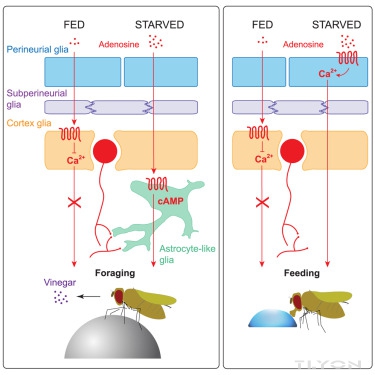
动物的代谢状态强烈影响其行为。饥饿的动物优先考虑寻找食物和摄食的行为,而饱食的动物则抑制这些行为以从事其他活动。此外,神经元活动和突触传递是最昂贵的能源过程。然而,神经元不能从循环中摄取营养。相反,胶质细胞除了调节神经元的活动和行为外,还履行这种高度进化保守的功能。然而,不同的胶质细胞亚型如何感知代谢状态和调节行为尚不完全清楚。在这里,我们揭示了两种类型的胶质细胞介导的调节代谢状态依赖的行为。在缺乏食物的果蝇中,星形胶质细胞样胶质细胞和神经周围胶质细胞分别促进觅食和摄食,而皮质胶质细胞抑制这些行为。我们进一步表明,腺苷和腺苷受体调节细胞内钙水平在这些胶质细胞亚型,最终控制行为。本研究揭示了不同类型胶质细胞如何感知动物的代谢状态并相应地调节其行为的机制。
···
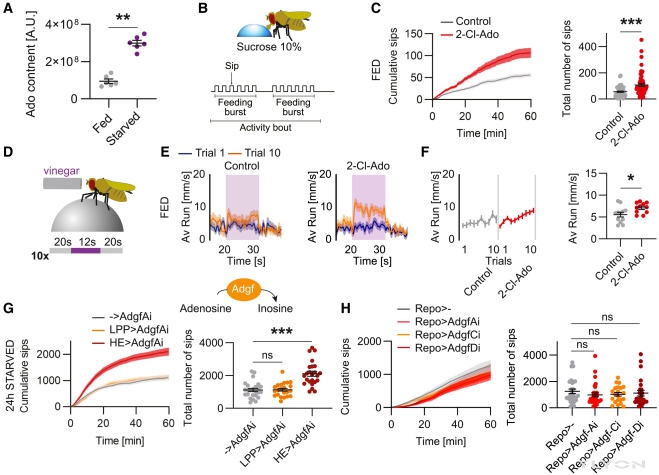
Figure 1 Extracellular adenosine is increased in food-deprived flies and promotes feeding and food-odor tracking behavior
We next assessed whether elevated adenosine impacts feeding behavior by mimicking starvation in fed flies. Wild-type flies were fed standard food supplemented with the chemically stable adenosine receptor (AdoR) agonist 2-chloroadenosine (2 mM).43 To analyze the impact of this manipulation on feeding behavior, we used the FlyPAD feeding assay44 (Figures 1B and S1A). Interestingly, we found that systemic and chronic AdoR activation significantly increased the number of sips taken on 10% sucrose in fed flies, mimicking starved flies’ behavior (Figure 1C). The FlyPAD assay also enables detailed feeding pattern analysis.44 Similar to rodents, flies feed in activity bouts—when the animal visits the food source—subdivided into bursts of sips45 (Figure 1B). As expected, 24-h-starved wild-type flies showed increased sip duration, burst number and duration, and more activity bouts compared to fed flies44 (Figures S1B–S1G). Similarly, 2-chloroadenosine-fed flies visited sucrose drops more frequently and displayed longer and more frequent feeding bursts (Figures S1H–S1M).
In addition to the FlyPAD, we used an olfactory-driven spherical treadmill paradigm that we previously developed as a proxy for metabolic-state-dependent persistence in foraging behavior46 (Figure 1D). In brief, we have shown that hungry flies persistently track vinegar odor—a food-predicting cue—with increasing effort over ten trials in the absence of food reward, while fed flies do not. Remarkably, feeding flies with 2-chloroadenosine prior to the experiment induced a starvation-like state: fed flies track the successive vinegar-odor stimuli more persistently and more quickly (Figures 1E and 1F).
···
Method details
FlyPAD feeding assay
FlyPAD feeding experiments were performed as previously described.44 Single flies were transferred into the behavioral arena by mouth aspiration and left to feed for 1 h on two 5μL drops of low-temperature melting agarose (1.5%) supplemented with 10% sucrose. Experiments were conducted in a climate chamber where a temperature of 25°C and 60% humidity were maintained. For optogenetic genetic experiments, we used the closed-loop stimulation paradigm described by Moreira et al.65 In this system, CsChrimson was activated by red light (625nm; 30μW/mm2) for a continuous period of 10 s when the fly’s proboscis contacted the drop of sucrose. Capacitance signal analysis was conducted using a custom-made MATLAB script provided by Pavel Itskov. The structure of feeding behavior was analyzed following the same parameters as described before44 (Figure 1B). The cumulated and total number of sips, number of activity bouts and number of feeding bursts were summed for the two electrodes. The sip durations, inter-sips intervals, durations of activity bouts and durations of feeding bursts were averaged for the two electrodes.

