微信公众号


Dual roles of Drosophila reward-encoding dopamine neurons in regulating innate and learned behaviors
Fiorella V. Lozada-Perdomo et al. https://doi.org/10.1101/2025.05.26.656192
SUMMARY
Dopaminergic neurons (DANs) play a key role in learning the value of cues that predict reward. The fruit fly Drosophila has provided a powerful model to dissect the mechanisms by which reward-encoding DANs mediate reward learning. However, the role of these DANs in regulating innate behaviors is less clear. Here, we show that activating the entire population of reward-encoding DANs in Drosophila drives innate aversion in multiple behavioral assays, including feeding, locomotion, and spatial preference, even as these neurons confer a positive value onto associated cues to drive future learned attraction. Activating subsets of DANs reveals that the effects on innate and learned behaviors are dissociable. Based on known circuitry, it is likely that innate aversion and learned attraction elicited by DANs arise from distinct effects – direct activation versus synaptic plasticity – on the same target neurons. These results reveal distinct roles for reward-encoding DANs in guiding immediate and future behavior.
多巴胺能神经元(DANs)在学习预测奖赏的线索价值方面起着关键作用。果蝇提供了一个强有力的模型来剖析奖赏编码DANs介导奖赏学习的机制。然而,这些DAN在调节先天行为中的作用尚不清楚。在这里,我们发现激活果蝇中的整个奖赏编码DAN群体在多种行为分析中驱动先天性厌恶,包括摄食、运动和空间偏好,即使这些神经元赋予相关线索正值以驱动未来学习的吸引力。激活DANs亚群表明,对先天行为和习得行为的影响是不可分离的。根据已知的电路,DAN诱发的先天性厌恶和习得性吸引很可能来自于对同一目标神经元的不同影响——直接激活与突触可塑性。这些结果揭示了奖励编码DAN在指导当前和未来行为方面的独特作用。
···
RESULTS
Both silencing and activation of PAM DANs reduce feeding
Given the known role of PAM DANs in encoding reward signals, we asked how the activity of PAM DANs influences sugar feeding. We targeted the entire population of PAM DANs using R58E02-Gal4, a well-characterized and highly specific line that has been used in many previous studies.8–10,14,15,23 We verified the expression pattern of R58E02-Gal4 using immunostaining (Figure 1A), confirming that the only labeled cells other than PAM DANs are cells in the optic lobe that were reported to be glia.8 In earlier studies24,25 we confirmed that PAM DANs are activated when flies taste sugar, as previously reported.8,22 In addition, we verified that optogenetic activation of PAM DANs using R58E02-Gal4 to express UAS-Chrimson, encoding a light-gated cation channel,26 causes robust appetitive learning (Figures 1B-C). In our learning assay (Figure 1B), the conditioned odor (CS+) is presented for 1 minute along with PAM activation, followed by 1 minute presentation of a control odor (CS-) without neuronal activation, and flies then choose between the CS+ and CS-. We observed strong preference for the CS+ (Figure 1C), as expected based on the known role of PAM DANs in associative learning.8,9,12,13
PAM DANs的沉默和激活都会减少摄食
鉴于已知的PAM-DANs在编码奖赏信号中的作用,我们询问PAM-DANs的活性如何影响糖的摄食。我们使用R58E02-Gal4对整个PAM-DANs群体进行了靶向研究,R58E02-Gal4是一种特性良好且高度特异的细胞系,已在许多以前的研究中使用。8–10、14、15、23我们使用免疫染色法验证了R58E02-Gal4的表达模式(图1A),确认除了PAM-DANs之外,唯一标记的细胞是视叶中报告为胶质细胞的细胞。8在以前的研究24、25中,我们确认了PAM-DANs在果蝇尝到糖时被激活,正如以前报告的那样。8、22此外,我们验证了PAM-DANs使用R58E02-Gal4表达UAS Chrimson,编码一种光。门控阳离子通道,26引起强烈的食欲学习(图1B-C)。在我们的学习实验(图1B)中,条件气味(CS+)与PAM激活一起呈现1分钟,然后呈现1分钟无神经元激活的控制气味(CS-),然后果蝇在CS+和CS-之间选择。根据已知PAM DANs在联想学习中的作用,我们观察到对CS+的强烈偏好(图1C)。8,9,12,13
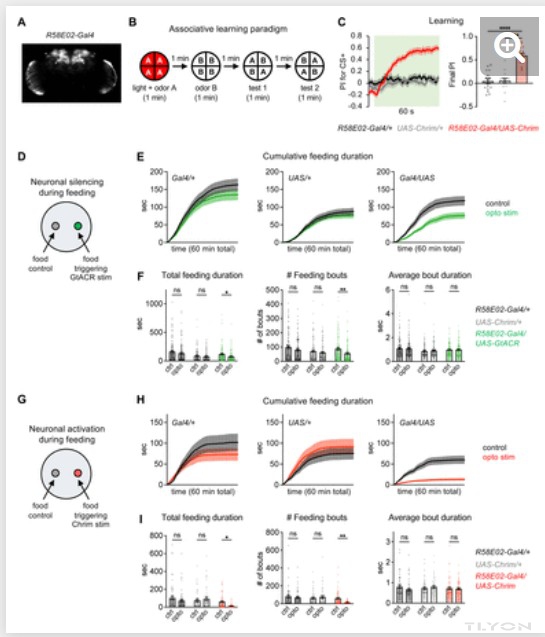
Figure 1.Both activation and silencing of the entire PAM DAN population reduce feeding
(A) Expression pattern of R58E02-Gal4 driving UAS-Chrimson.
(B) Schematic of the associative learning assay, showing odor A as the CS+ and odor B as the CS-. Learned preference is quantified by the preference index (PI), defined as (# flies in the CS+ quadrants – # flies in the CS-quadrants) / total # flies. Data from test 1 and test 2 are combined and are treated as separate trials.
(C) PAM activation using R58E02-Gal4 driving UAS-Chrimson elicits appetitive learning, as quantified by the PI for the CS+ over time (left) or final PI (right) (n = 16 trials, 8 sets of flies). Genotypes were compared using one-way ANOVA followed by Dunnett’s post-tests. In all figures showing learning experiments, green shading indicates odors on and the final PI represents the average PI over the last 5 sec, unless otherwise specified. In the line graph, experimental flies may appear to show a negative PI before odor onset because of the repeated tests that are combined (see panel B); after the first test some flies continue to reside in the CS+ quadrants, which become the CS-quadrants for the second test.
(D-I) Both PAM silencing (panels D-F, n = 117-123 flies) and activation (panels G-I, n = 49-60 flies) decrease sugar feeding in the optoPAD. Line graphs (E, H) show cumulative feeding duration over a 60 min assay on control versus optogenetic-linked food sources (100 mM sucrose) for each genotype. Bar graphs (F, I) show total values for various feeding metrics over the entire assay. Control and opto values were compared by two-way repeated measures ANOVA followed by Bonferroni’s post-tests.
For all figures: Flies carrying only the Gal4 (Gal4/+) or UAS (UAS/+) transgenes are used as controls. When comparing metrics across genotypes, experimental flies must be significantly different from both controls in order to show a positive effect. All graphs represent mean ± SEM, and points represent individual flies or trials. ****p<0.0001, ***p<0.001, **p<0.01, *p<0.05, ns = not significant (p>0.05).
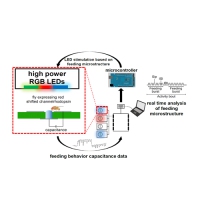
Having verified the role of PAM DANs in appetitive learning, we then tested whether their activity regulates sugar feeding. We measured feeding in the optoPAD, which uses a capacitance sensor to detect feeding events on two different food sources.27,28 We used closed-loop light stimulation to optogenetically activate or silence PAM DANs whenever the fly interacted with one food source (100 mM sucrose), while a second identical food source not linked to optogenetic stimulation served as the control. For all feeding experiments, flies were food-deprived for one day (unless otherwise specified) to ensure that they were motivated to consume sugar, and the same conditions were used for other behavioral experiments described later.
在验证了PAM-DANs在食欲学习中的作用后,我们测试了PAM-DANs的活性是否调节糖的摄食。我们在optoPAD中测量摄食,它使用电容传感器检测两个不同食物源上的摄食事件。27,28我们使用闭环光刺激,每当果蝇与一个食物源(100 mM蔗糖)相互作用时,光激活或沉默PAM DANs,而另一个与光生刺激无关的相同食物源作为对照。在所有的进食实验中,果蝇被剥夺一天的食物(除非另有规定),以确保它们有动机消耗糖,并且在后面描述的其他行为实验中使用相同的条件。