微信公众号


Tongue-on-a-Chip: Parallel Recording of Sweet and Bitter Receptor Responses to Sequential Injections of Pure and Mixed Sweeteners
舌片芯片:对纯甜味剂和混合甜味剂连续注射的甜味和苦味受体反应的并行记录
Abstract
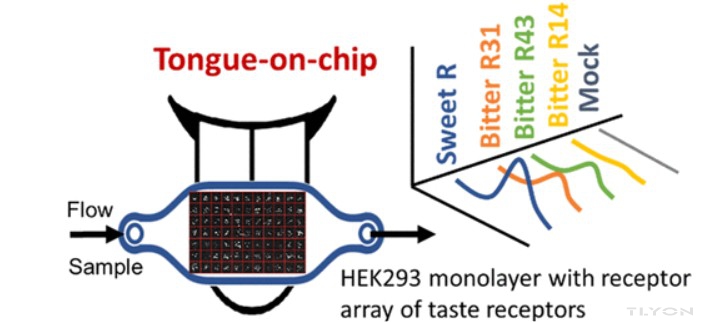
A microfluidic tongue-on-a-chip platform has been evaluated relative to the known sensory properties of various sweeteners. Analogous metrics of typical sensory features reported by human panels such as sweet taste thresholds, onset, and lingering, as well as bitter off-flavor and blocking interactions were deduced from the taste receptor activation curves and then compared. To this end, a flow cell containing a receptor cell array bearing the sweet and six bitter taste receptors was transiently exposed to pure and mixed sweetener samples. The sample concentration gradient across time was separately characterized by the injection of fluorescein dye. Subsequently, cellular calcium responses to different doses of advantame, aspartame, saccharine, and sucrose were overlaid with the concentration gradient. Parameters describing the response kinetics compared to the gradient were quantified. Advantame at 15 μM recorded a significantly faster sweetness onset of 5 ± 2 s and a longer lingering time of 39 s relative to sucrose at 100 mM with an onset of 13 ± 2 s and a lingering time of 6 s. Saccharine was shown to activate the bitter receptors TAS2R8, TAS2R31, and TAS2R43, confirming its known off-flavor, whereas addition of cyclamate reduced or blocked this saccharine bitter response. The potential of using this tongue-on-a-chip to bridge the gap with in vitro assays and taste panels is discussed.
微流控芯片味觉平台已经相对于各种甜味剂的已知感官特性进行了评估。从味觉受体激活曲线中推断出人类小组报告的典型感官特征的类似指标,如甜味阈值、开始和持续时间,以及苦味和阻断相互作用,然后进行比较。为此,将含有带有甜味和六种苦味受体的受体细胞阵列的流动池暂时暴露于纯甜味剂和混合甜味剂样品中。通过注射荧光素染料分别表征样品浓度随时间的梯度。随后,细胞对不同剂量的advantame、阿斯巴甜、糖精和蔗糖的钙反应被浓度梯度覆盖。与梯度相比,描述响应动力学的参数被量化。与100 mM的蔗糖相比,15μM的Advantame记录到明显更快的甜味开始时间为5±2秒,持续时间为39秒,开始时间为13±2秒。糖精被证明可以激活苦味受体TAS2R8、TAS2R31和TAS2R43,证实了其已知的异味,而添加甜蜜素可以减少或阻断这种糖精苦味反应。讨论了使用这种芯片上的舌头弥合体外检测和味觉面板差距的潜力。