微信公众号


Conserved NT5C2 links context-specific behaviors with psychiatric and metabolic risk
Thiago C. Moulin et al.
Abstract
Background
The cytosolic 5′-nucleotidase II (NT5C2) enzyme has been implicated in both psychiatric disorders and metabolic traits, but whether these associations reflect a shared biological basis remains unclear. Here we combined cross-species approaches to investigate how reduced NT5C2 function shapes behavior.
背景
胞质5′-核苷酸酶II(NT5C2)已被证实与精神疾病及代谢特征相关,但其间是否存在共同的生物学基础尚不明确。本研究结合跨物种方法,探究NT5C2功能降低如何影响行为。
Results
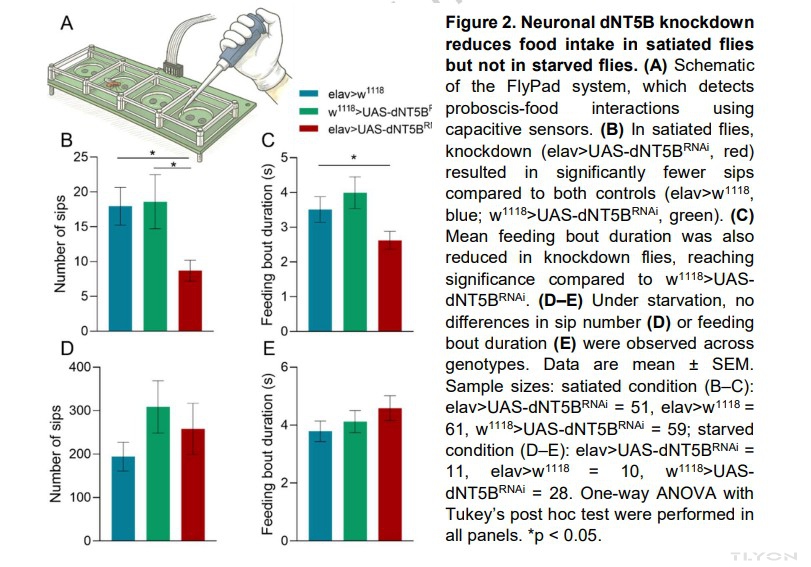
In Drosophila melanogaster, neuronal knockdown of the ortholog dNT5B increased activity around light-dark transitions, reduced sleep fragmentation, and selectively suppressed food intake under satiated conditions. Moreover, analysis of mouse phenotyping data revealed that whole-body Nt5c2 knockout alters locomotor activity, sensorimotor gating, and anxiety-related behaviors. Finally, human variant-trait associations showed reproducible enrichment in both metabolic domains, including body composition and BMI, and neuro-psychiatric outcomes such as schizophrenia, smoking, and anxiety.
结果
在黑腹果蝇中,神经元特异性敲低直系同源基因dNT5B会增强光暗转换期间的活动性、降低睡眠片段化,并在饱食状态下选择性抑制摄食。此外,对小鼠表型数据的分析表明,全身性Nt5c2基因敲除会改变自主活动、感觉运动门控及焦虑相关行为。最后,人类基因变异与表型的关联分析显示,NT5C2相关变异在代谢领域(包括身体成分和体重指数)与神经精神领域(如精神分裂症、吸烟和焦虑)均存在可重复的富集效应。
Conclusions
Together, these phenotypic findings indicate that NT5C2 is a conserved neuro-metabolic regulator, linking energy-related pathways to specific behavioral dimensions that may underlie its pleiotropic impact on psychiatric and metabolic risk.
结论
这些表型研究结果表明,NT5C2是一种保守的神经代谢调节因子,它将能量相关通路与特定的行为维度相联系,这可能是其影响精神与代谢风险多效性作用的生物学基础。
···
Methods
Feeding Behavior
Feeding behavior was quantified using the FlyPad system, a capacitive-based platform that records proboscis-food interactions [36]. Individual flies were transferred by mouth aspiration into arenas containing two food channels, one filled with 4-5 µL of standard liquid food and the other left empty. The primary outcome measure was the number of sips, defined as a single proboscis-food interaction, which strongly correlates with actual food intake volume [36]. As a secondary metric, we analyzed the mean duration of feeding bouts (food-approach episodes), reflecting the average feeding time per approach. Both measures have been validated as reliable proxies of food consumption. Assays were conducted for one hour between 08:00 and 11:00, with control and knockdown groups tested in parallel under identical conditions. Both fed and starved flies were assayed; for the starvation condition, flies were deprived of food for ~16 h with water available. Each group included at least 8 flies per assay. Flies that remained completely immobile for the duration of the assay were excluded from analysis. The experiments were performed using the 2018 FlyPad version.
方法
摄食行为分析
采用FlyPad系统量化摄食行为,该系统为基于电容感应原理的平台,可记录果蝇喙部与食物的接触情况[36]。通过口吸法将单只果蝇转移至具有两个食物通道的进食仓中,其中一条通道填充4-5 µL标准液体食物,另一条通道保持空置。主要观测指标为吮吸次数(定义为单次喙与食物接触),该指标与实际摄食量高度相关[36]。次要指标为平均取食时段持续时间(即每次接近食物的平均取食时长)。两项指标均已被验证为反映食物消耗量的可靠参数。实验于08:00至11:00间持续一小时,对照组与基因敲低组在相同条件下同步测试。实验对象包括饱食状态与饥饿状态果蝇;饥饿处理组果蝇禁食约16小时(期间可自由饮水)。每组实验至少包含8只果蝇,实验期间全程静止不动的个体被排除分析。本实验采用2018年版FlyPad系统完成。