微信公众号


Neprilysin 1 in the Mushroom Body controls Feeding behavior by regulating SIFamide levels in Drosophila melanogaster
El-Sayed Baz et al.
SUMMARY
Feeding-related behavior in Drosophila melanogaster encompasses olfactory and gustatory detection of odors, foraging, and food intake. In Drosophila melanogaster, the neuropeptide SIFamide (SIFa), has been shown to integrate hunger signals to promote feeding in Drosophila and is considered a central regulator of mutually exclusive behavioral states. Here, we identify the mushroom bodies as a key downstream circuit of SIFamidergic neurons for regulation of food-seeking and feeding. Furthermore, we show that mushroom bodies are not merely downstream effectors but actively shape SIFamidergic signaling through the peptidase Neprilysin 1 for which SIFamide is a substrate. Thus, SIFa signaling is embedded within a feedforward-feedback circuit that couples internal state to the selection and execution of feeding behavior. We propose that the distinct neuronal subtypes postsynaptic to the elaborately arborized SIFamidergic neurons define discrete neuronal subroutines that differentially control the mutually exclusive behaviors related to sexual reproduction, sleep and feeding. Our findings reveal an evolutionary ancient peptidergic system that is modified by recruitment of novel genes for the flexible control of distinct behavioral programs and feeding strategies.
摘要
果蝇的摄食相关行为包括对气味的嗅觉和味觉检测、觅食以及食物摄入。在果蝇中,神经肽SIF酰胺(SIFa)已被证明可整合饥饿信号以促进摄食,并被认为是相互排斥的行为状态的核心调节因子。在此,我们确定蘑菇体是SIF酰胺能神经元调控觅食和摄食的关键下游回路。此外,我们证明蘑菇体不仅仅是下游效应器,还通过肽酶脑啡肽酶1(SIF酰胺是其底物)主动塑造SIF酰胺能信号传导。因此,SIFa信号传导嵌入在一个前馈-反馈回路中,该回路将内部状态与摄食行为的选择和执行耦合起来。我们提出, intricately arborized SIF酰胺能神经元突触后的不同神经元亚型定义了离散的神经元子程序,这些子程序差异性地控制与性繁殖、睡眠和摄食相关的相互排斥的行为。我们的发现揭示了一个进化上古老的肽能系统,该系统通过招募新基因而被修饰,以实现对不同行为程序和摄食策略的灵活控制。
MATERIALS AND METHODS材料与方法
Behavioral assays行为学实验
FlyPAD进食检测
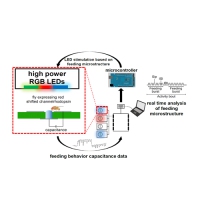
Feeding behavior was assessed using the fly Proboscis and Activity Detector (flyPAD) system (Easy Behavior, Lisbon, Portugal), which enables high-resolution quantification of feeding events through capacitive sensing (Itskov et al., 2014). The system consists of electrodes that detect changes in capacitance when a fly contacts the food source via its proboscis allowing individual feeding events to be recorded. For each experiment, 5 µL of food was loaded into one well of the flyPAD arena. The food consisted of 2% yeast, 1% agar, and 10% sucrose. The second well was left empty but sealed from below with tape to prevent escape while maintaining the structural integrity of the arena. All experiments were conducted between ZT1 and ZT3 to control for circadian influences on feeding behavior. Flies were loaded into the flyPAD arenas in a completely dark room under dim red light illumination. Dim red light conditions were used throughout handling and experimentation to minimize visual cues and ensure that behavior was primarily guided by non-visual sensory modalities, such as olfaction. The flyPAD system was operated inside an incubator maintained at 22 °C, also under constant redlight conditions, to ensure stable environmental parameters throughout the experiment. Prior to each experimental session, the recording system (Bonsai software) was checked to ensure that all sensors were functioning optimally. Flies were introduced individually into the arenas using an aspiration device and allowed to adapt for 15 minutes before the start of recording. Feeding behavior was subsequently recorded for 1 hour. Capacitive signals corresponding to feeding events were acquired using the flyPAD system and processed via Bonsai software for downstream analysis as per the manufacturer’s instructions.
使用fly Proboscis and Activity Detector(flyPAD)系统(Easy Behavior, Lisbon, Portugal)评估摄食行为,该系统通过电容传感实现对摄食事件的高分辨率定量(Itskov等,2014)。该系统由电极组成,当果蝇通过其喙接触食物源时,电极检测电容变化,从而记录单个摄食事件。每次实验时,将5 µL食物加载到flyPAD arena的一个孔中。食物由2%酵母、1%琼脂和10%蔗糖组成。第二个孔留空,但从下方用胶带密封以防止逃逸,同时保持arena的结构完整性。所有实验均在ZT1至ZT3之间进行,以控制昼夜节律对摄食行为的影响。果蝇在完全黑暗的房间中、昏暗红光照明下被装入flyPAD arena。在整个操作和实验过程中均使用昏暗红光条件,以尽量减少视觉线索,确保行为主要受非视觉感觉模态(如嗅觉)引导。flyPAD系统在维持在22 °C的培养箱内运行,同样处于恒定红光条件下,以确保整个实验期间环境参数稳定。每次实验会话前,检查记录系统(Bonsai软件)以确保所有传感器功能正常。使用吸引装置将果蝇单独引入arena,并允许其适应15分钟后再开始记录。随后记录摄食行为1小时。对应于摄食事件的电容信号通过flyPAD系统采集,并按照制造商说明通过Bonsai软件处理以供下游分析。