微信公众号


Zohre Panahidizjikan et al.
Abstract
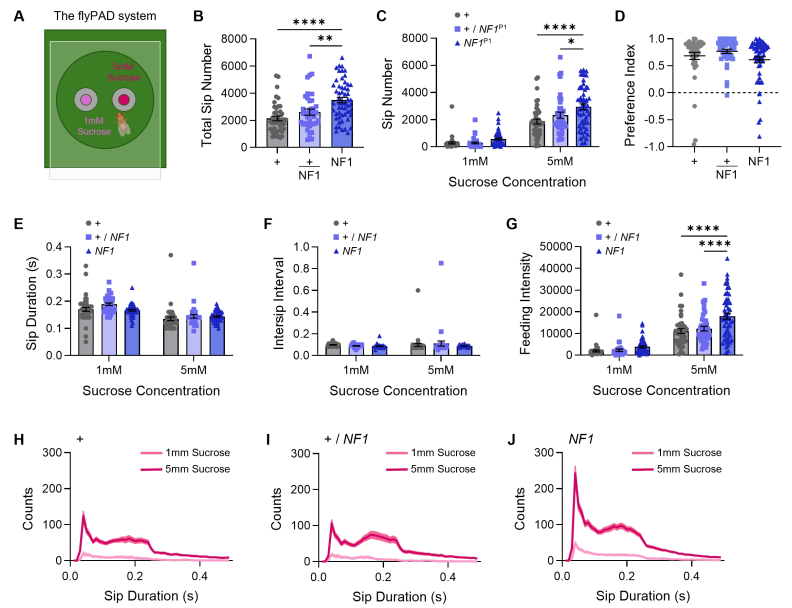
Neurofibromatosis type 1 (NF1) is caused by the loss of neurofibromin, a protein shown to regulate metabolism and feeding behavior in Drosophila melanogaster. Using the FlyPad two-choice feeding assay, we compared feeding microstructure between NF1 null mutants, NF1 heterozygotes, and wildtype controls. We find that NF1 mutants took significantly more sips of sucrose and with greater urgency, without changes in sip duration or sucrose taste sensitivity. Overall, these results suggest loss of NF1 increases feeding frequency
摘要
1型神经纤维瘤病(NF1)由神经纤维瘤蛋白缺失引起,该蛋白已被证明可调节黑腹果蝇的代谢和摄食行为。使用FlyPad双选择摄食实验,我们比较了NF1无效突变体、NF1杂合子和野生型对照的摄食微结构。我们发现,NF1突变体吸食蔗糖的次数显著更多且更急迫,而吸食持续时间或蔗糖味觉敏感性没有变化。总体而言,这些结果表明NF1缺失会增加摄食频率。
Methods方法
Drosophila care and maintenance 果蝇饲养维护
Flies were maintained on standard cornmeal-molasses-yeast food (Bloomington Recipe, Genesee Scientific, San Diego,CA) at 25°C and at ~50% relative humidity under a 12 h light: 12 h dark cycle. Mated ~3–5-day-old male flies werecollected under light CO2 anesthesia and allowed to recover for at least 24 h prior to all experiments.
果蝇饲养于标准玉米粉-糖蜜-酵母饲料(Bloomington配方,Genesee Scientific,美国加利福尼亚州圣地亚哥),温度25°C,相对湿度约50%,12小时光照:12小时黑暗周期。在轻度CO2麻醉下收集交配过的3–5日龄雄蝇,并在所有实验前至少恢复24小时。
FlyPAD two-choice feeding assay FlyPAD双选择摄食实验
Feeding behavior was quantified using the flyPAD (fly Proboscis and Activity Detector; Itskov et al., 2014). Prior to testing, flies were starved for 18 h in vials on wet Kimwipe paper. On the day of testing, individual males were aspirated without anesthesia into flyPAD arenas configured for a two-choice assay, with the two food channels containing either 1 mM or 5 mM sucrose in 1% agarose. Flies were allowed to feed for 60 min, after which data were extracted and analyzed using established flyPAD analysis software (Itskov et al., 2014). The Preference Index (PI) was calculated as: (# sips of 5 mM sucrose − # sips of 1 mM sucrose) / (total # of sips), where a value of 1.0 indicates complete preference for 5mM sucrose and a value of -1.0 indicates a complete preference for 1mM sucrose. Feeding Intensity was calculated as: # sips / sip duration (Collins et al., 2026). Flies that did not feed were excluded from downstream analyses. The resulting sample size for this experiment were as follows: controls (N = 43), NF1 P1 heterozygotes (N = 39), and NF1 P1 mutants (N = 55). All experiments were performed between ZT 0-2 at 25°C.
使用flyPAD(果蝇进食行为活动检测器;Itskov等,2014)量化摄食行为。测试前,果蝇在铺有湿Kimwipe纸的小瓶中饥饿18小时。测试当天,无需麻醉,将单只雄蝇用吸虫管吸入配置为双选择实验的flyPAD装置中,两个食物通道分别含1 mM或5 mM蔗糖的1%琼脂糖。允许果蝇摄食60分钟,之后使用既有的flyPAD分析软件提取并分析数据(Itskov等,2014)。偏好指数(PI)计算公式为:(5 mM蔗糖吸食次数 − 1 mM蔗糖吸食次数)/(总吸食次数),其中1.0表示完全偏好5 mM蔗糖,-1.0表示完全偏好1 mM蔗糖。摄食强度计算公式为:吸食次数/吸食持续时间(Collins等,2026)。未摄食的果蝇被排除在下游分析之外。本实验最终样本量为:对照(N = 43)、NF1 P1杂合子(N = 39)和NF1 P1突变体(N = 55)。所有实验均在25°C下于ZT 0-2之间进行。
Statistical analysis统计分析
Feeding metrics are visualized as graphs displaying mean ± standard error. Dots represent individual fly measurements. Four independent runs were performed. The data were not normally distributed and so the non-parametric Kruskal-Wallis test was used to compare genotypes. To compare genotypes and sucrose concentration, a restricted maximum likelihood (REML) estimation was used. All post hoc analyses were performed using Dunn’s multiple comparisons test. Data were analyzed and visualized using InStat software (GraphPad Software 11.0).
摄食指标以显示均值±标准误的图呈现。点代表单只果蝇的测量值。进行了四次独立实验。数据不服从正态分布,因此使用非参数Kruskal-Wallis检验比较基因型。为比较基因型和蔗糖浓度,使用限制性最大似然(REML)估计。所有事后分析均使用Dunn多重比较检验。数据使用InStat软件(GraphPad Software 11.0)分析和可视化。