 微信公众号


Cédric Martin et al.
This article describes the use of the spray flash evaporation (SFE) process for the preparation of fine powders of three oxidizing compounds: potassium nitrate (KNO3), ammonium perchlorate (NH4ClO4, AP), and ammonium dinitramide (NH4N(NO2)2, ADN). Miniaturization of particles decreased the melting points of fusible oxidizers (KNO3 and ADN) and changed the decomposition mechanism of AP. These oxidizers (RAW and processed by SFE) were mixed in stoichiometric proportions with fine phosphorus(v) nitride (P3N5) powder (3.2 m2 g−1). The debated heat of formation of P3N5 was revisited and the new enthalpy of formation is: Alt-text is not available for this image.. The compositions prepared from finer oxidizer powders were less sensitive to impact but more sensitive to electrostatic discharge. Calorimetric experiments showed that heats of explosion of AP/P3N5 and ADN/P3N5 mixtures were higher than those of pure oxidizers, demonstrating that the phosphorus contained in P3N5 acts as a fuel in the reaction. The combustion of oxidizer/P3N5 mixtures in the form of loose powders showed that combustion propagated more easily in a confined volume (calorimeter) than in open air. Flame tests showed that the thermal properties of the oxidizer have a determining influence on the ignition and propagation of combustion. In the case of fusible oxidants, the advantage of a fine initial structure is not obvious, since melting causes the molten domains to coalesce into large droplets before the reaction takes place. Conversely, the use of a fine AP powder facilitates ignition and the spread of combustion in AP/P3N5 mixtures.
本文描述了采用喷雾闪蒸(SFE)工艺制备三种氧化性化合物的细粉末:硝酸钾(KNO₃)、高氯酸铵(NH₄ClO₄,AP)和二硝酰胺铵(NH₄N(NO₂)₂,ADN)。颗粒的微细化降低了易熔氧化剂(KNO₃ 和 ADN)的熔点,并改变了 AP 的分解机理。这些氧化剂(原料态和经 SFE 处理态)与细颗粒氮化磷(V)(P₃N₅)粉末(3.2 m² g⁻¹)按化学计量比例混合。本文重新考察了 P₃N₅ 存在争议的生成热,新的生成焓为:Alt-text is not available for this image.。由更细氧化剂粉末制备的组合物对撞击较不敏感,但对静电放电更为敏感。量热实验表明,AP/P₃N₅ 和 ADN/P₃N₅ 混合物的爆热高于纯氧化剂,证明 P₃N₅ 中所含的磷在反应中充当燃料。氧化剂/P₃N₅ 混合物以松散粉末形式进行的燃烧实验表明,燃烧在密闭体积(量热仪)中比在开放空气中更容易传播。火焰试验表明,氧化剂的热性质对点火和燃烧传播具有决定性影响。对于易熔氧化剂而言,细初始结构的优势并不明显,因为在反应发生之前熔化会导致熔融区域聚并成大液滴。相反,使用细 AP 粉末有利于 AP/P₃N₅ 混合物的点火和燃烧传播。
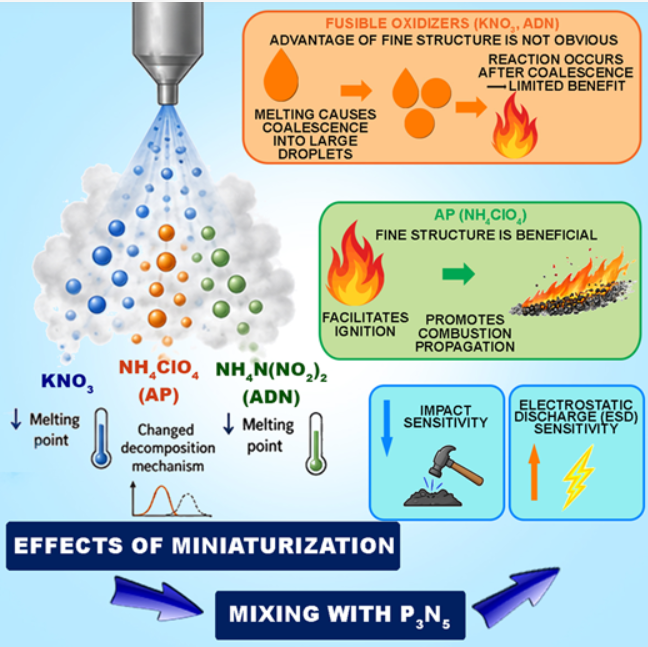
This article describes the use of the spray flash evaporation (SFE) process for the preparation of fine powders: potassium nitrate (KNO3), ammonium perchlorate (NH4ClO4, AP), and ammonium dinitramide (NH4N(NO2)2, ADN), for P3N5 based compositions.
本文描述了采用喷雾闪蒸(SFE)工艺制备细粉末:硝酸钾(KNO₃)、高氯酸铵(NH₄ClO₄,AP)和二硝酰胺铵(NH₄N(NO₂)₂,ADN),用于 P₃N₅ 基组合物。
Materials and methods材料与方法
Materials材料
Potassium nitrate, ammonium dinitramide (ADN), acetone, and ethyl acetate were purchased from Carl Roth GmbH + Co. KG, Germany. Phosphorus(v) nitride (P3N5) was provided by Lutradyn. All the reagents were used without purification except for ammonium perchlorate, which was synthesized in the laboratory by the reaction of perchloric acid (70%, ROTIPURAN®, from Carl Roth) with a solution of ammonia (30–33%, extra pure, from Carl Roth) used in excess. The ammonia solution, cooled in an ice bath, is added dropwise to the perchloric acid solution, which is also cooled in an ice bath and kept under stirring. The end of the salification reaction is marked by an increase in the pH of the reaction medium. Water is added to the final solution to dissolve the formed AP precipitate. The liquid phase is finally removed by evaporation under reduced pressure in a rotary evaporator, resulting in a coarse ammonium perchlorate powder.
硝酸钾、二硝酰胺铵(ADN)、丙酮和乙酸乙酯购自德国 Carl Roth GmbH + Co. KG。氮化磷(V)(P₃N₅)由 Lutradyn 提供。除高氯酸铵外,所有试剂均未经纯化直接使用;高氯酸铵由实验室通过高氯酸(70%,ROTIPURAN®,购自 Carl Roth)与过量氨水溶液(30–33%,特纯,购自 Carl Roth)反应合成。将氨水溶液在冰浴中冷却后,逐滴加入同样在冰浴中冷却并持续搅拌的高氯酸溶液中。成盐反应的终点以反应介质 pH 升高为标志。向最终溶液中加水以溶解生成的 AP 沉淀。最后在旋转蒸发器中减压蒸发除去液相,得到粗高氯酸铵粉末。
Characterization of raw material and compositions原料与组成表征
All commercial materials and prepared samples were analyzed by scanning electron microscopy (SEM) using a FEI Nova NanoSEM 450 (Hillsboro, Oregon, USA) equipped with a field emission gun in order to characterize the morphology of the products.
所有商用材料和制备的样品均使用配备场发射枪的FEI Nova NanoSEM 450(美国俄勒冈州希尔斯伯勒)扫描电子显微镜(SEM)进行分析,以表征产物的形貌。
Energy-dispersive X-ray spectroscopy (EDS) mapping was also performed on oxidizer/P3N5 compositions to determine and visualize the spatial distribution of the elements.
还对氧化剂/P3N5组合物进行了能量色散X射线光谱(EDS)面分布分析,以确定并可视化各元素的空间分布
The thermal properties of raw commercial materials, prepared oxidizers and oxidizer/P3N5 compositions were characterized by differential scanning calorimetry (DSC) and thermogravimetric analysis (TGA) measurements with a DSC2500 DSC and a SDT650 TGA respectively, from TA instruments (New Castle, USA).
原料商用材料、制备的氧化剂以及氧化剂/P3N5组合物的热性能分别通过差示扫描量热法(DSC)和热重分析(TGA)进行表征,所用仪器分别为TA Instruments(美国纽卡斯尔)的DSC2500 DSC和SDT650 TGA。
DSC measurements were carried out in pressure-resistant gold crucibles M20, provided by TÜV SÜD Process Safety, Basel, Schweiz, which can be used up to 400 °C, with a sample masses of about 1 mg and a heating rate of 5 K min−1. TGA experiments were performed in open alumina crucibles (90 µL from TA instruments), with sample masses of about 3 mg and a heating rate of 5 K min−1, under a N2/O2 (80/20 vol/vol%) gas flow.
DSC测量在耐压金坩埚M20中进行,该坩埚由TÜV SÜD Process Safety(瑞士巴塞尔)提供,最高可使用至400 °C,样品质量约为1 mg,升温速率为5 K min⁻¹。TGA实验在敞口氧化铝坩埚(TA Instruments,90 µL)中进行,样品质量约为3 mg,升温速率为5 K min⁻¹,在N2/O2(80/20 vol/vol%)气体流下进行。
The infrared (FT-IR) spectra of the different materials and sample were measured with an INVENIO® FT-IR spectrometer from Bruker (Germany). The transmittance was recorded for a range of wavenumbers from 50 to 4000 cm−1.
不同材料和样品的红外(FT-IR)光谱使用Bruker(德国)的INVENIO® FT-IR光谱仪测量。透射率记录的波数范围为50至4000 cm⁻¹。
X-ray powder diffraction (XRPD) analysis was performed on a Bruker AXS D8 Advance (Karlsruhe, Germany) X-ray powder diffractometer using Cu-Kα radiation (λCu = 1.54056 Å) and a Lynxeye detector. The acceleration voltage was 40 kV and the operating current was 40 mA. The step size for all scans was set to 0.0193° (2θ). Diffractograms were recorded with the angle varying from 10° to 90°. The loose powder samples were measured on a rotated sample holder.
X射线粉末衍射(XRPD)分析在Bruker AXS D8 Advance(德国卡尔斯鲁厄)X射线粉末衍射仪上进行,使用Cu-Kα辐射(λCu = 1.54056 Å)和Lynxeye探测器。加速电压为40 kV,工作电流为40 mA。所有扫描的步长设定为0.0193°(2θ)。衍射图记录的角度范围为10°至90°。松散粉末样品在旋转样品台上测量。
The Raman spectra of the P3N5 samples were recorded between 200 cm−1 and 1200 cm−1 (spectral resolution: ± 1 cm−1) on an “InVia Raman Microscope” from Renishaw (Software Wire 3.2) with a magnification of 100×. The wavelength of the laser was 514 nm (internal grating 2400 lines/mm) and the acquisition time was set to 30 s performing 3 scans. No thermally induced decomposition of the samples was observed during the measurements. For the baseline correction (asymmetric least squares smoothing; ALSS) and normalization ([0,100]) of the recorded spectra, the software “Origin 2023b” was used.
P3N5样品的拉曼光谱在200 cm⁻¹至1200 cm⁻¹之间(光谱分辨率:± 1 cm⁻¹)记录,使用Renishaw的“InVia Raman Microscope”(Software Wire 3.2),放大倍数为100×。激光波长为514 nm(内部光栅2400线/mm),采集时间设定为30 s,进行3次扫描。测量过程中未观察到样品的热诱导分解。对于记录光谱的基线校正(非对称最小二乘平滑;ALSS)和归一化([0,100]),使用了“Origin 2023b”软件。
The measurements of the specific surface area of the materials used in this research were carried out using an ASAP2020 type BET device from Micromeritics. It is determined by nitrogen (N2) absorption at 77 K, following the method established by Brunauer, Emmett and Teller. The samples were degassed under vacuum beforehand, as follows: 3h at 200 °C for P3N5 and 16h at 80 °C for KNO3 and PA.
本研究所用材料的比表面积测量使用Micromeritics的ASAP2020型BET装置进行。通过77 K下的氮气(N2)吸附测定,遵循Brunauer、Emmett和Teller建立的方法。样品事先在真空下脱气,具体如下:P3N5在200 °C下脱气3 h,KNO3和PA在80 °C下脱气16 h。


