微信公众号


David Toppe et al.
Abstract
Neural circuits must remain functionally stable while adapting to changing demands and levels of stress. While this balance is thought to rely on plasticity programs integrating molecular and activity-dependent signals, mechanistic models of how such adaptations are orchestrated remain limited. Here, we show that impairment of autophagy in the Drosophila mushroom body (MB) induces brain-wide, post-transcriptional remodeling of presynaptic active zones, characterized by increased expression levels of active zone scaffold proteins, reduced abundance of calcium channel subunits, and elevated levels of Shaker-type potassium channels. This remodeling promotes organismal resilience, as reflected by increased sleep and extended lifespan. Mechanistically, early-life activation of this program is sufficient to extend lifespan, identifying synaptic remodeling as a causal driver of adaptive responses. MB-specific autophagy disruption further leads to non-cell autonomous accumulation of autophagic substrates across the brain, consistent with a system-level proteostatic imbalance in which degradative pathways remain active, but appear insufficient to match cargo load. Our findings identify autophagy in the mushroom body as a key regulator of brain-wide synaptic architecture and resilience, and establish a genetically tractable model for how local proteostatic impairment can trigger adaptive, system-level circuit remodeling.
摘要
神经环路必须在适应不断变化的需求和应激水平的同时保持功能稳定。人们认为这种平衡依赖于整合分子信号和活动依赖性信号的可塑性程序,但此类适应如何被协调的机制模型仍然有限。在这里,我们表明,果蝇蘑菇体(MB)中的自噬损伤会诱导全脑范围的突触前活性区转录后重塑,其特征是活性区支架蛋白表达水平升高、钙通道亚基丰度降低以及 Shaker 型钾通道水平升高。这种重塑促进机体韧性,表现为睡眠增加和寿命延长。机制上,生命早期激活该程序足以延长寿命,从而将突触重塑确定为适应性反应的因果驱动因素。MB 特异性自噬破坏进一步导致自噬底物在整个大脑中的非细胞自主积累,这与系统级蛋白质稳态失衡一致:降解途径仍然活跃,但似乎不足以匹配货物负荷。我们的发现确定蘑菇体中的自噬是全脑突触结构和韧性的关键调节因子,并建立了一个遗传可操作的模型,说明局部蛋白质稳态损伤如何触发适应性、系统级环路重塑。
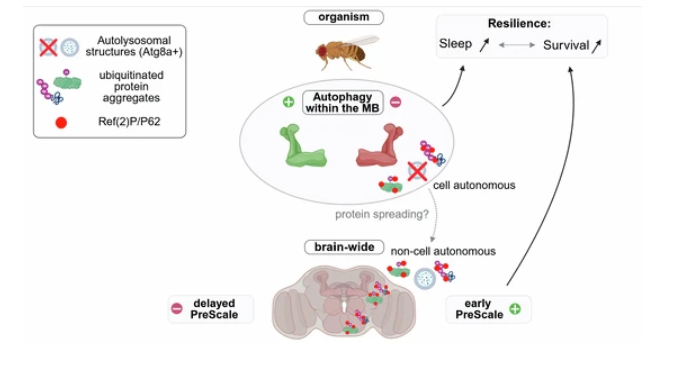
Neuronal networks must maintain functional stability despite fluctuating metabolic demands and diverse cellular stressors, highlighting the importance of circuit-level adaptive resilience mechanisms. This study shows that local autophagy impairment within the Drosophila mushroom body (MB) induces system-level proteostatic imbalance, while simultaneously activating a brain-wide presynaptic resilience program (termed PreScale) that promotes sleep and longevity.
神经环路必须在代谢需求波动和多种细胞应激源存在的情况下维持功能稳定,这凸显了环路层面适应性韧性机制的重要性。本研究表明,果蝇蘑菇体(MB)内的局部自噬损伤会诱导系统级蛋白质稳态失衡,同时激活一个全脑突触前韧性程序(称为 PreScale),该程序促进睡眠和长寿。
Early-life PreScale activation in response to impaired MB autophagy promotes survival and increases sleep.
早期生命阶段因 MB 自噬受损而激活 PreScale,可促进生存并增加睡眠。
PreScale is characterized by post-transcriptional remodeling of presynaptic active zones, including increased abundance of active zone scaffold proteins, reduced levels of calcium channel subunits, and changes in Shaker-type potassium channels.
PreScale 的特征是突触前活性区的转录后重塑,包括活性区支架蛋白丰度增加、钙通道亚基水平降低以及 Shaker 型钾通道的变化。
MB 自噬的局部损伤导致自噬底物在整个大脑中的非细胞自主积累,可能涉及 Ref(2)P/P62 蛋白聚集体从 MB 神经元向其他脑区的部分重新分布。
Ref(2)P/P62 aggregates detected outside the MB co-localize with ATG8a and are found in degradative lysosomal compartments, indicating active degradative processing rather than complete proteostasis failure in these brain regions.
在 MB 之外检测到的 Ref(2)P/P62 聚集体与 ATG8a 共定位,并存在于降解性溶酶体区室中,表明这些脑区存在活跃的降解加工,而非完全的蛋白质稳态失败。
Sleep measurements睡眠测量
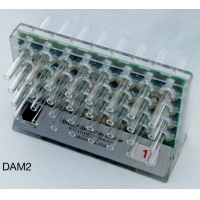
Sleep and locomotor activity measurements of single adult flies was performed with Drosophila activity monitors (DAM2) from Trikinetics Inc. (Waltham, MA., USA) at 25 °C and 65% humidity in a 12/12 h light/dark cycle (Huang et al, 2020; Pfeiffenberger et al, 2010). At day 3 of age, individual flies were loaded under brief CO2 anesthesia into single Trikinetics glass tubes (5 mm inner diameter and 65 mm length) containing a food source of 5% sucrose and 2% agar on one side. The activity of individual flies was recorded as the number of beam crosses within 1 min, and periods of inactivity without any beam cross of 5 min or longer were considered as sleep (Shaw et al, 2000). Activity measurements were performed over 5 consecutive days, and measurements from the first 2 days were discarded due to entrainment of the flies to the new environment. Data from the last 3 days was averaged, and sleep parameters were analyzed using the Sleep and Circadian Analysis MATLAB Program (SCAMP) (Vecsey et al, 2024). Activity measurements of flies which died during the experiment were discarded from the analysis. For sleep measurements of aged flies, 13-day-old flies were loaded into Trikinetics glass tubes so that they reached 15 days of age at the start of the relevant recording period.
使用 Trikinetics Inc.(美国马萨诸塞州沃尔瑟姆)的果蝇活动监测器(DAM2)在 25 °C、65% 湿度、12/12 小时明/暗周期下对单只成年果蝇进行睡眠和运动活动测量(Huang 等,2020;Pfeiffenberger 等,2010)。在果蝇 3 日龄时,于短暂 CO2 麻醉下将单只果蝇装入单个 Trikinetics 玻璃管(内径 5 mm,长 65 mm),管的一侧含有由 5% 蔗糖和 2% 琼脂组成的食物源。单只果蝇的活动记录为 1 分钟内穿越光束的次数,无任何光束穿越且持续 5 分钟或更长的静止期被视为睡眠(Shaw 等,2000)。活动测量连续进行 5 天,由于果蝇对新环境的适应,前 2 天的测量数据被丢弃。对最后 3 天的数据取平均值,并使用睡眠与昼夜节律分析 MATLAB 程序(SCAMP)分析睡眠参数(Vecsey 等,2024)。实验中死亡果蝇的活动测量数据从分析中剔除。对于老年果蝇的睡眠测量,将 13 日龄果蝇装入 Trikinetics 玻璃管,使其在相关记录期开始时达到 15 日龄。
Newly eclosed flies were collected every other day and maintained in groups of mixed sex for 2 days. At day 3, male and female flies were quickly separated under CO2 anesthesia and sorted into populations of ~25 individuals per vial. This procedure was repeated on different days with different cohorts of collected flies, until 6-10 experimental vials per sex and genotype were set up. The established longevity cohorts were transferred onto fresh food every second day, and the number of individual dead flies per vial was recorded at each time point of transfer.
每隔一天收集新羽化果蝇,并以混合性别群体维持 2 天。第 3 天,在 CO2 麻醉下快速分离雄蝇和雌蝇,并分装为每瓶约 25 只的群体。该程序在不同日期用不同批次收集的果蝇重复进行,直至每个性别和基因型设置 6–10 个实验瓶。建立的长寿队列每隔一天转移到新鲜食物上,并在每次转移的时间点记录每瓶死亡个体数。
H2O2 survival assay
Freshly eclosed flies were collected every other day and maintained in groups of mixed sexes for 2 days. Subsequently, 45 flies per genotype and sex were transferred onto big vials containing three filter papers soaked with 2 ml of solution consisting of 2% H2O2 and 5% sucrose diluted in water. Experimental cohorts were transferred onto new vials with freshly prepared H2O2 solutions every second day, and the number of individual death events in each vial was scored exactly at the same time of the day every 24 h.
每隔一天收集新羽化果蝇,并以混合性别群体维持 2 天。随后,每个基因型和性别取 45 只果蝇转移到装有 3 张滤纸的大瓶中,滤纸浸有 2 ml 由 2% H2O2 和 5% 蔗糖溶于水组成的溶液。实验队列每隔一天转移到装有新鲜配制 H2O2 溶液的新瓶,并每 24 小时在每天同一时间准确记录每瓶个体死亡事件数。
Feeding assay摄食实验
Feeding assays were performed using FlyPad as previously described (Itskov et al, 2014). 3-day-old female flies were sorted in groups of 25 under brief CO₂ anesthesia and housed in vials containing standard cornmeal food. Two days later, individual flies were transferred by mouth aspiration into FlyPad arenas and allowed to feed for 1 h on two 5 μl drops of 1% agar (Karl Roth, 4508.1) supplemented with 5% sucrose (Sigma-Aldrich, S5016) and 5% yeast extract (Karl Roth, 2363.3). Experiments were conducted in the dark at 25 °C and 70% relative humidity. For H₂O₂ feeding experiments, groups of female flies were transferred 1 day prior to the experiment to vials containing filter paper soaked with 2% H₂O₂ and 5% sucrose diluted in tap water. During the feeding assay, flies were allowed to feed on food containing 2% H₂O₂, 1% agar, 5% sucrose, and 5% yeast extract. The total number of sips for each fly was calculated using a custom-made MATLAB script provided by the manufacturer. Data from flies showing signs of technical malfunction (rare) or zero sips on one of the electrodes were excluded from further analysis (Musso et al, 2019).
使用 FlyPad 按先前描述进行摄食实验(Itskov 等,2014)。3 日龄雌蝇在短暂 CO2 麻醉下按 25 只一组分选,并饲养于含标准玉米粉食物的瓶中。两天后,用口吸法将单只果蝇转移至 FlyPad 实验区,并让其取食两滴 5 μl 含 5% 蔗糖和 5% 酵母提取物的 1% 琼脂,持续 1 小时。实验在黑暗、25 °C 和 70% 相对湿度下进行。对于 H2O2 摄食实验,雌蝇组在实验前 1 天转移到含滤纸的瓶中,滤纸浸有溶于自来水的 2% H2O2 和 5% 蔗糖。摄食实验期间,让果蝇取食含 2% H2O2、1% 琼脂、5% 蔗糖和 5% 酵母提取物的食物。每只果蝇的总啜吸次数使用制造商提供的定制 MATLAB 脚本计算。出现技术故障迹象(罕见)或某一电极上啜吸次数为零的果蝇数据被排除在进一步分析之外(Musso 等,2019)。