微信公众号


Ana Cornelia Butcaru et al. https://doi.org/10.3390/horticulturae12111442
Abstract
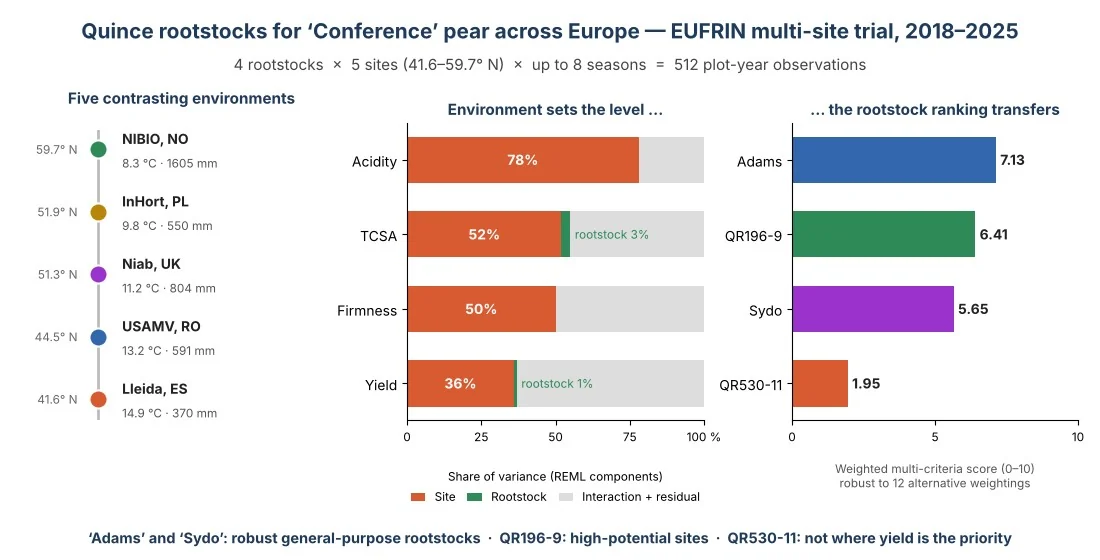
Pear (Pyrus communis L.) production in high-density orchards depends critically on the choice of a size-controlling, precocious and quality-neutral rootstock, yet most comparative information still originates from single-site trials. We evaluated four quince (Cydonia oblonga Mill.) rootstocks—‘Adams’, ‘Sydo’, QR196-9 and QR530-11—under the cultivar ‘Conference’ across five contrasting European environments of the EUFRIN thematic orchard network (Spain, Romania, United Kingdom, Poland and Norway; 41.6–59.7° N), compiling 512 plot-year observations (replicate plots of four to five trees) over up to eight seasons (2018–2025). Vegetative growth (trunk cross-sectional area, TCSA; tree height; annual increment), productivity (yield, yield efficiency, crop load, cumulative yield) and fruit quality (weight, size distribution, firmness, total soluble solids, titratable acidity and their ratio) were analyzed by two-way and per-year ANOVA, linear mixed models (LMM), variance partitioning, Finlay–Wilkinson joint regression and Wricke ecovalence stability statistics, correlation and principal component analysis. Site was the dominant source of variation for all traits (variance components up to 78% for titratable acidity, 52% for TCSA and 36% for yield), whereas the rootstock contribution, although small, was largest for TCSA (≈3%). Across environments, TCSA ranked QR196-9 > ‘Adams’ > ‘Sydo’ > QR530-11 (LMM: QR196-9 +2.77 cm2, QR530-11 −2.83 cm2 vs. ‘Adams’; p = 0.002), and QR530-11 was consistently the least productive (−1.66 kg tree−1 vs. ‘Adams’; p < 0.001). Including the trunk size at planting as a covariate did not change the QR196-9 contrast and only attenuated that of QR530-11, which had the smallest nursery trees. QR196-9 behaved as an environment-responsive genotype (regression coefficient b ≈ 1.15–1.30), whereas QR530-11 was low-yielding, with its below-average slope (b ≈ 0.82) being largely a scale effect of its smaller size (b ≈ 1.0 on the log scale); ‘Sydo’ combined intermediate performance with the highest stability. Titratable acidity was the only trait showing a significant site × rootstock interaction, confined to the Lleida site. A weighted multi-criteria index computed from the site- and year-adjusted mixed-model estimates of eight criteria, including rootstock suckering, ranked ‘Adams’ highest (7.44/10), followed by QR196-9 (5.75), ‘Sydo’ (5.64) and QR530-11 (2.76), and rootstock differences attenuated as orchards approached canopy closure. Because the four rootstocks were compared within one complete multi-site trial rather than at single sites, the mixed-model estimates are site-corrected and the resulting recommendations are transferable across environments: ‘Adams’ and ‘Sydo’ as robust general-purpose rootstocks, QR196-9 for high-potential sites and caution with QR530-11 where yield is the priority.
Keywords: Pyrus communis; quince rootstock; TCSA; yield efficiency; fruit quality; G × E stability; LMM; multi-environment trial
关键词: 欧洲梨(Pyrus communis);榅桲砧木;树干横截面积(TCSA);产量效率;果实品质;基因型与环境互作稳定性(G × E 稳定性);线性混合模型(LMM);多点环境试验
2. Materials and Methods材料与方法
At Lleida, firmness, TSS and titratable acidity were determined with a Pimprenelle automatic fruit analysis device (Setop Giraud-Technologie, Cavaillon, France), which measures flesh firmness with an electronic penetrometer and then presses each fruit to extract its juice; the juice is read on an integrated electronic refractometer for TSS, and a fixed volume of juice from each fruit is titrated by acid–base reaction to obtain the titratable acidity, which the instrument reports in g L . At NIBIO and USAMV, fruit firmness was measured on the peeled flesh at two opposite points of the equatorial zone of each fruit with a hand penetrometer fitted with the 8 mm diameter tip (0.5 cm cross-section) that is standard for pear—a T.R. Turoni FT‑series hand penetrometer (T.R. Turoni S.r.l.,Forlì, Italy) at USAMV and an equivalent 0.5 cm plunger at NIBIO—and firmness was expressed in kg cm . Titratable acidity (TA) was determined by automated potentiometric titration with 0.1 mol L-1 NaOH. At NIBIO, 1 mL of juice was diluted with 50 mL of distilled water, stirred for 10 s and titrated to a pH 8.2 endpoint on () a T5 automatic titrator with an InMotion Pro autosampler and a DGi115‑SC electrode (Mettler‑Toledo GmbH, Greifensee, Switzerland) in duplicate. At USAMV, TA was determined on a TitroLine 5000 automatic titrator (SI Analytics GmbH, Mainz, Germany) following ISO 750 [60] and AOAC 942.15 [61], titrating to a pH 8.1 endpoint. The two titration protocols reach an essentially identical endpoint (pH 8.1–8.2), and all three laboratories express the result as the dominant fruit acid; accordingly, all TA values are reported as malic acid and, for direct comparison across sites, expressed as grams of malic acid per 100 mL of juice (g 100 mL ), with the Lleida values delivered in g L-1 being divided by ten. At NIBIO and USAMV, the total soluble solids (TSS) were measured with a digital refractometer (°Brix), and the TSS/acidity ratio was computed as a maturity index.