 微信公众号


Impact of spoilage organisms on the behavior of foodborne pathogens on fresh produce during storage
Blanca Ruiz-Llacsahuanga et al.
Highlights
•Spoilage impact on produce safety remains understudied.
•Natural co-occurrences of plant and human pathogens are complex.
•Spoilage organisms can promote or inhibit the growth of foodborne pathogens.
•Storage conditions, fungicide, and wax application affect spoilage and pathogen survival.
亮点
-
腐败微生物对农产品安全性的影响仍研究不足。
-
植物病原体与人类病原体的自然共存关系复杂。
-
腐败微生物可促进或抑制食源性病原体的生长。
-
贮藏条件、杀菌剂和蜡的应用会影响腐败微生物和病原体的存活。
The natural co-occurrence of plant pathogens, spoilage organisms, and human foodborne pathogens highlights the need to better understand their interactions and the resulting impact on foodborne pathogen contamination in fresh produce during storage. This review examined the influence of postharvest storage conditions on the behavior of both foodborne pathogens and spoilage organisms in fresh fruits and vegetables, using studies published between 2021 and 2026. Key factors such as storage temperature, relative humidity, atmosphere gas composition, packaging, and the application of fungicides, waxes, and coatings were discussed. In addition, the interactions between spoilage organisms and foodborne pathogens were explored, with potential mechanisms affecting human foodborne pathogen survival identified, including pH shifts, production of antimicrobial secondary metabolites, nutrient competition, and weakened postharvest commodity immune response. However, given the complexity of plant-human pathogen relationships, which may vary by spoilage organism, strain, agricultural commodity type, and storage conditions, further research is necessary. Finally, mitigation strategies to minimize microbial and spoilage risks during storage were discussed, and targeted directions for future research were proposed.
摘要
植物病原体、腐败微生物和人类食源性病原体的自然共存,凸显了有必要更好地理解它们之间的相互作用及其对新鲜农产品贮藏期间食源性病原体污染的最终影响。本综述基于2021年至2026年间发表的研究,考察了采后贮藏条件对新鲜果蔬中食源性病原体和腐败微生物行为的影响。讨论了贮藏温度、相对湿度、气调气体组成、包装以及杀菌剂、蜡和涂膜应用等关键因素。此外,还探讨了腐败微生物与食源性病原体之间的相互作用,并识别了影响人类食源性病原体存活的潜在机制,包括pH变化、抗菌次级代谢产物的产生、营养竞争以及采后农产品免疫反应减弱。然而,鉴于植物—人类病原体关系的复杂性,其可能因腐败微生物、菌株、农产品类型和贮藏条件而异,仍需进一步研究。最后,讨论了减少贮藏期间微生物和腐败风险的缓解策略,并提出了未来研究的重点方向。
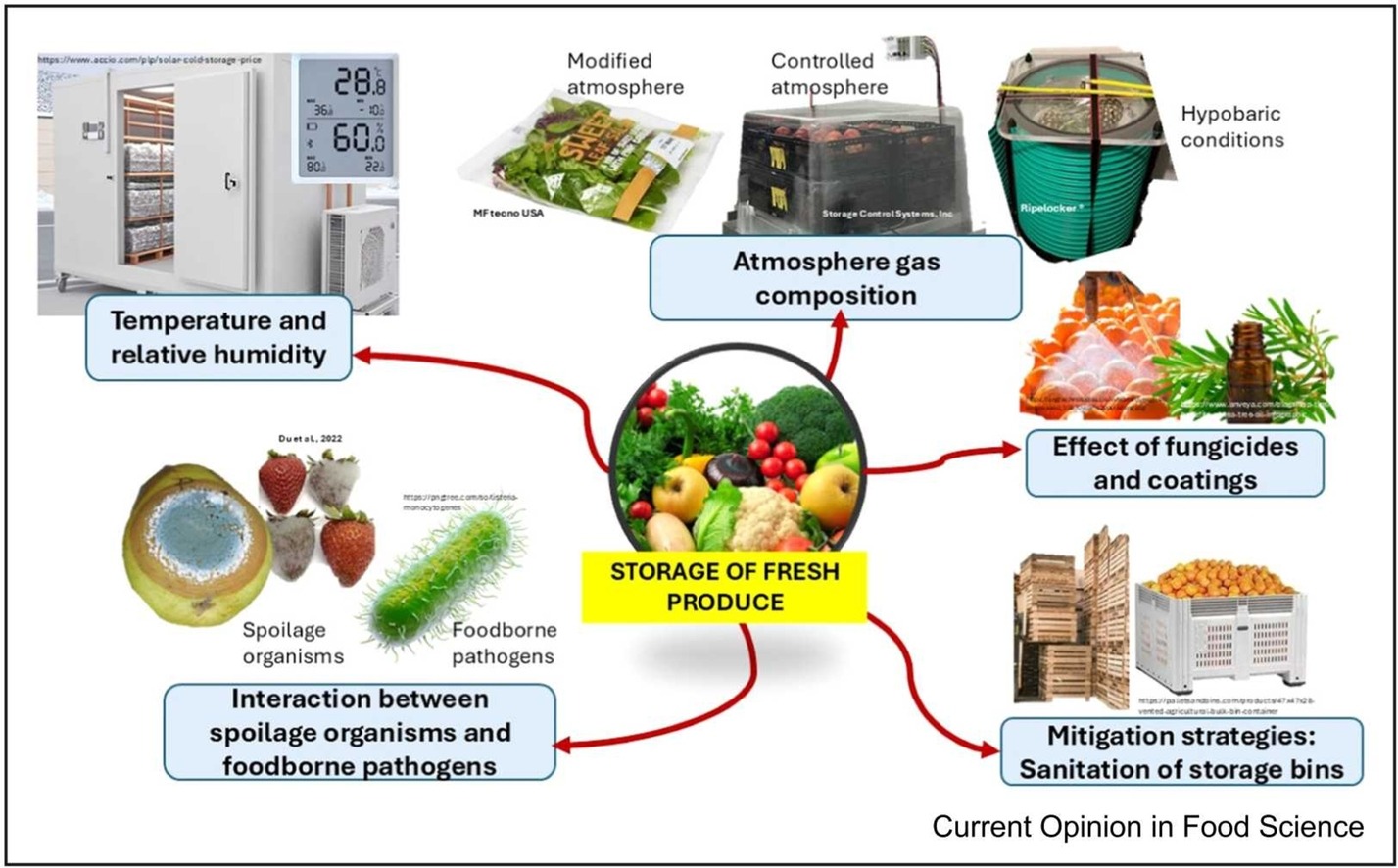
Introduction Fresh produce are perishable commodities with storage potential ranging from short-term (e.g. up to 2 weeks for leafy greens and tomatoes), to medium-term storage (e.g. up to 5 weeks for blueberries, cantaloupes, and peppers), or long-term storage (e.g. up to 12 months for apples). Growers and packers extend shelf life based on different factors such as physicochemical properties, ripening patterns, respiration rates, cultivar, and market demands. Shelf life depends on several storage conditions, including temperature, atmospheric gas levels, relative humidity, and packaging. Nonetheless, these postharvest conditions can also create opportunities for the growth and persistence of spoilage organisms and foodborne pathogens. In the fresh produce industry, the foodborne pathogens of greatest concern include Salmonella enterica, Shiga-toxin producing Escherichia coli (STEC), Listeria monocytogenes, norovirus, and parasites such as Cyclospora cayetanensis. Understanding the impact of spoilage organisms on foodborne pathogen survival remains challenging due to the diversity of organisms naturally present in the environment and the wide range of intrinsic and extrinsic factors encountered across the fresh produce industry.
引言
新鲜农产品是易腐商品,其贮藏潜力从短期(例如叶菜和番茄可达2周)、中期贮藏(例如蓝莓、哈密瓜和辣椒可达5周)到长期贮藏(例如苹果可达12个月)不等。种植者和包装商根据理化性质、成熟模式、呼吸速率、品种和市场需求等不同因素来延长货架期。货架期取决于多种贮藏条件,包括温度、气体水平、相对湿度和包装。然而,这些采后条件也可能为腐败微生物和食源性病原体的生长和持续存在创造机会。在新鲜农产品行业中,最受关注的食源性病原体包括肠道沙门氏菌、产志贺毒素大肠杆菌(STEC)、单核细胞增生李斯特菌、诺如病毒,以及卡耶塔环孢子虫等寄生虫。由于环境中天然存在的微生物多样性以及新鲜农产品行业中遇到的各种内在和外在因素,理解腐败微生物对食源性病原体存活的影响仍然具有挑战性。


