 微信公众号


Samuel Kochlia et al.
https://doi.org/10.1016/j.postharvbio.2026.114879
Highlights
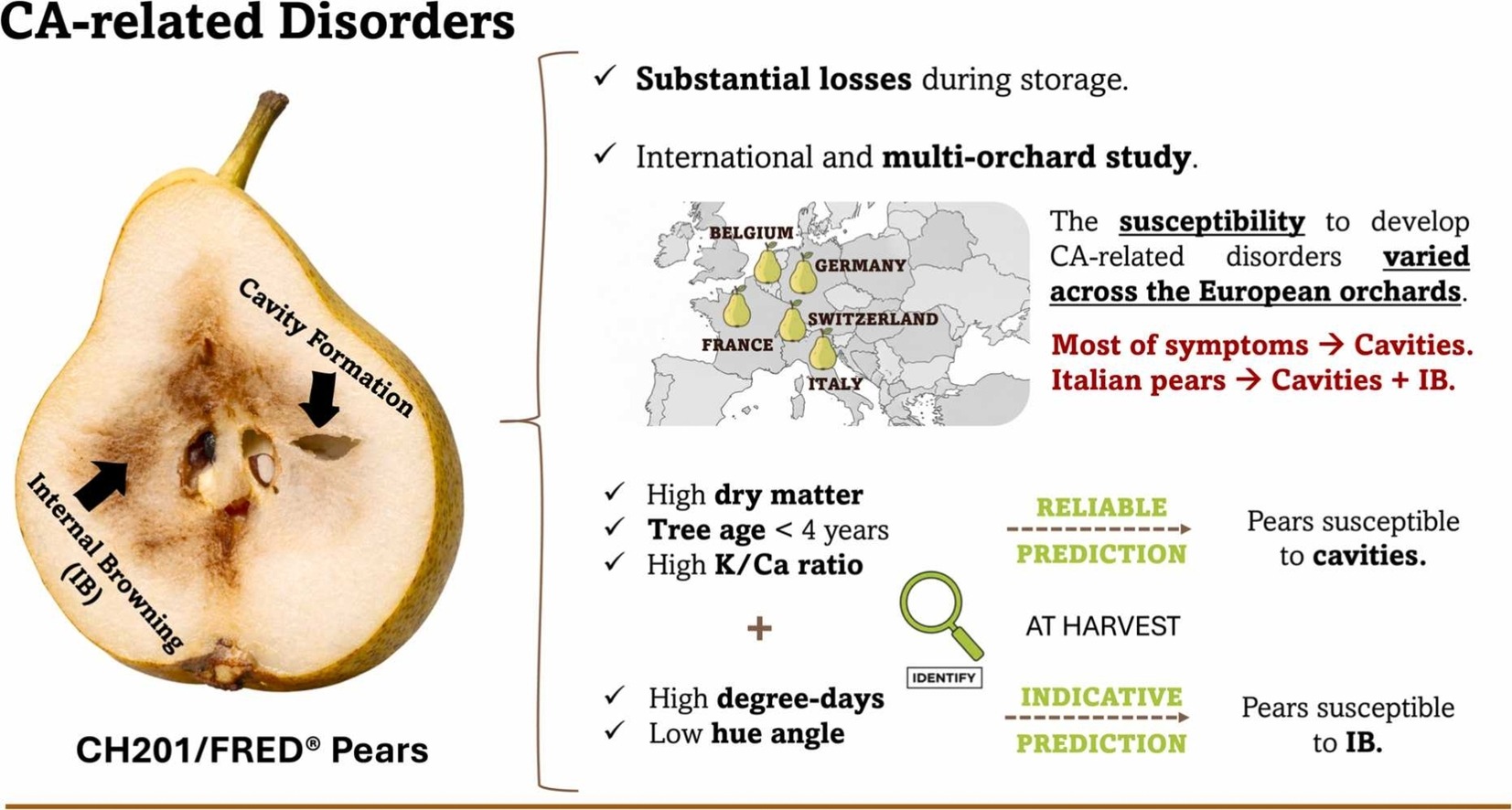
•Incidences of storage disorders of the CH201/FRED cultivar showed regional variation.
•The association between the K/Ca ratio and cavity incidence varied among countries.
•Dry matter, tree age, K/Ca ratio, color are potential indicators of cavity risk.
亮点
CH201/FRED 品种的贮藏病害发病率存在地区差异。
钾钙比(K/Ca)与空腔发病率之间的关联因国家而异。
干物质、树龄、钾钙比、色泽是空腔风险的潜在指标。
Abstract
‘CH201/FRED®’ is a recently launched bicolored pear cultivar with long-term storage potential. However, its susceptibility to disorders associated with controlled atmosphere (CA) storage, primarily cavities and internal browning (IB), can result in substantial losses during storage. This study investigated whether mineral composition, together with quality parameters, density, seed number, and orchard-related characteristics at harvest, could be used to predict the susceptibility of ‘CH201/FRED®’ pears to CA-related disorders. Pears from 20 orchards in Belgium, France, Germany, Italy, and Switzerland, harvested at commercial maturity according to the recommendations established for each production region, were stored in the same CA room. The incidence of cavities and IB varied widely among orchards and could not be attributed to a single parameter across all orchards. The potassium (K) to calcium (Ca) ratio (K/Ca) showed a positive correlation with cavity development, particularly when only Swiss and Italian orchards were considered. Fruit density, dry matter, total soluble solids, and color were also associated with susceptibility to cavity development. A preliminary predictive model identified dry matter, tree age, and the K/Ca ratio as potentially useful indicators of cavity risk, although further validation across independent datasets, growing seasons, and storage conditions is required.
Keywords:Pyrus communis; Cavities; Internal browning; Mineral composition; Quality parameters; Orchard
关键词(Keywords):西洋梨(Pyrus communis);空化;内部褐变;矿质组成;品质参数;果园
2. Materials and methods材料与方法
2.2. Classical quality parameters
The fruit quality of 30 pears per orchard was determined on their arrival at the laboratory (referred to as ‘at harvest’ in this study). Skin color was assessed using a CM-600d spectrophotometer (Konica Minolta, Tokyo, Japan) operating in the CIE L*a*b* color space under D65 standard illumination. Color measurements were expressed as hue angles (hue, tan−1(b*/a*)), where 0° corresponded to red, 90° to yellow, and 180° to green. An automated Pimprenelle instrument (Setop Giraud-Technologie, Cavaillon, France) was used to determine mass (g), firmness (N), total soluble solids (TSS, %), and titratable acidity (TA, g/L). Firmness and TSS measurements were performed on individual fruit, while TA was measured on the juice obtained from 3 batches of 10 fruit per orchard. Firmness measurements were performed on unpeeled pears with a 0.5 cm2 probe.
每个果园 30 个梨的果实品质在其抵达实验室时测定(本研究中称为"采收时")。果皮颜色使用 CM-600d 分光测色仪(日本东京柯尼卡美能达公司,Konica Minolta)在 CIE L*a*b* 颜色空间、D65 标准光源条件下测定。颜色测量以色调角(hue,tan⁻¹(b*/a*))表示,其中 0° 对应红色、90° 对应黄色、180° 对应绿色。使用自动化的 Pimprenelle 仪器(法国 Cavaillon 的 Setop Giraud-Technologie 公司)测定质量(g)、硬度(N)、可溶性固形物(TSS,%)和可滴定酸(TA,g/L)。硬度和 TSS 在单个果实上测定,而 TA 则用每个果园 3 批、每批 10 个果实榨取的果汁测定。硬度测定在未去皮的梨上以 0.5 cm² 的探头进行。
