 微信公众号


Wathsala Ratnayake et al.
Abstract
Volatile organic compounds (VOCs), as a biological element released from plants, have been correlated with disease status. Although analysis of VOCs using GC-MS is a routine procedure, it has limitations, including being time-consuming, laboratory-based, and requiring specialist training. Electronic nose devices (E-nose) provide a portable and rapid alternative. This is the first pilot study exploring three types of commercially available E-nose to assess how accurately they could detect mango twig tip dieback and Panama disease in bananas. The devices were initially trained and validated on known volatiles, then pure cultures of Pantoea sp., Staphylococcus sp., and Fusarium odoratissimum, and finally, on infected and healthy mango leaves and field-collected, infected banana pseudo-stems. The experiments were repeated three times with six replicates for each host-pathogen pair. The variation between healthy and infected host materials was evaluated using inbuilt data analysis methods, mainly by principal component analysis (PCA) and cross-validation. GC-MS analysis was conducted contemporaneously and identified an 80% similarity between healthy and infected plant material. The portable C 320 was 100% successful in discriminating known volatiles but had a low capability in differentiating healthy and infected plant substrates. The advanced devices (PEN 3/MSEM 160) successfully detected healthy and diseased samples with a high variance. The results suggest that E-noses are more sensitive and accurate in detecting changes of VOCs between healthy and infected plants compared to headspace GC-MS. The study was conducted in controlled laboratory conditions, as E-noses are highly sensitive to surrounding volatiles.
摘要
挥发性有机化合物(VOCs)作为植物释放的生物成分,已被认为与病害状态相关。尽管使用GC-MS分析VOCs是一种常规方法,但其存在局限性,包括耗时、依赖实验室条件以及需要专业培训。电子鼻装置(E-nose)提供了一种便携、快速的替代方案。这是首个探索三种市售电子鼻的初步研究,旨在评估它们检测芒果枝梢顶枯病和香蕉巴拿马病的准确性。这些装置首先在已知挥发物上进行训练和验证,随后在Pantoea sp.、Staphylococcus sp.和Fusarium odoratissimum的纯培养物上进行训练和验证,最后在感染和健康的芒果叶片以及田间采集的感染香蕉假茎上进行检测。实验重复三次,每个宿主—病原物对设六个重复。健康与感染宿主材料之间的差异使用内置数据分析方法进行评估,主要是主成分分析(PCA)和交叉验证。同期进行了GC-MS分析,发现健康和感染植物材料之间的相似度为80%。便携式C 320在区分已知挥发物方面100%成功,但在区分健康和感染植物基质方面能力较低。更先进的设备(PEN 3/MSEM 160)成功检测出健康和患病样品,且差异较大。结果表明,与顶空GC-MS相比,电子鼻在检测健康和感染植物之间VOCs变化方面更灵敏、更准确。该研究是在受控实验室条件下进行的,因为电子鼻对周围挥发物高度敏感。
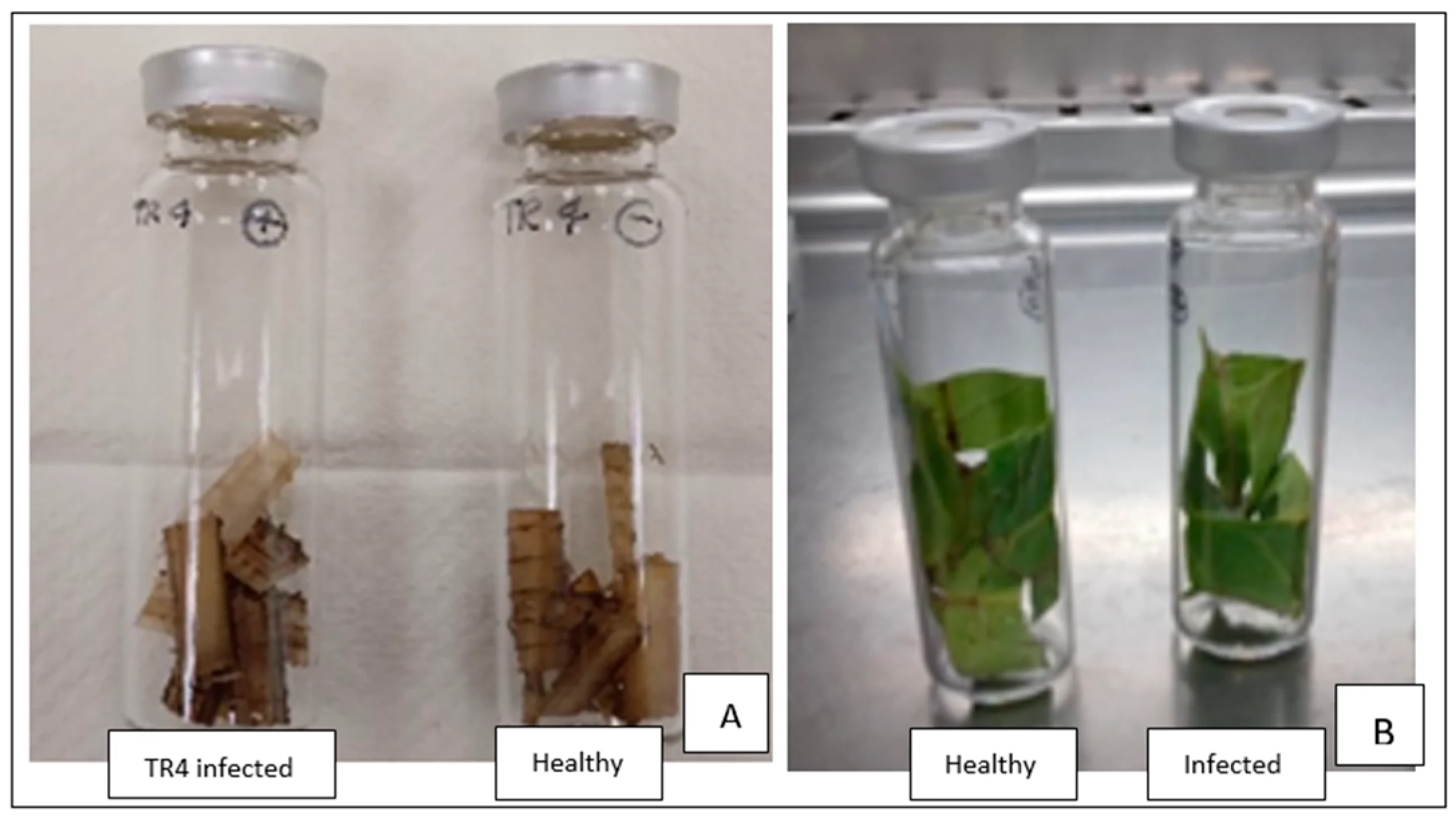
Figure 2. Thin strips of substrates were placed in 20 mL headspace glass vials prior to E-nose sampling. (A) Healthy and TR4-infected banana pseudo stems and (B) healthy and infected mango leaf samples.
Keywords: electronic nose; headspace gas chromatography-mass spectrometry (GC-MS) analysis; principal component analysis (PCA); volatile organic compounds (VOC); Panama disease; tropical race 4 (TR4); mango twig tip dieback (MTTD)
关键词: 电子鼻;顶空气相色谱—质谱(GC-MS)分析;主成分分析(PCA);挥发性有机化合物(VOC);巴拿马病;热带4号生理小种(TR4);芒果枝梢顶枯病(MTTD)
···
2.6. Data Analysis数据分析Inbuilt statistical analysis methods were utilised for three E-noses: Win Muster v.1.6 in PEN 3, CDA software, v.2.39 in MSEM 160, and inbuilt PC nose software in C 320. These tools were employed for data analysis via principal component analysis (PCA), a common pattern recognition method in E-nose analysis. PCA transforms the original dataset of correlated variables into linearly uncorrelated principal components [26], effectively reducing dimensions while retaining valuable information [27].
三款电子鼻均使用内置统计分析方法:PEN 3 中的 Win Muster v.1.6、MSEM 160 中的 CDA 软件 v.2.39,以及 C 320 中的内置 PC nose 软件。这些工具通过主成分分析(PCA)进行数据分析,PCA 是电子鼻分析中常用的一种模式识别方法。PCA 将原始的相关变量数据集转换为线性不相关的主成分[26],在保留有价值信息的同时有效降维[27]。
CDA software in MSEM 160 instrument monitors changes in the electrical, physical, optical and/or chemical properties of the internal arrays of chemical sensors. Changes in the sensor properties were identified and qualified by the software and translated into metrics during operation according to the explanation in the MSEM 160 user manual.
MSEM 160 仪器中的 CDA 软件监测内部化学传感器阵列的电学、物理、光学和/或化学性质变化。根据 MSEM 160 用户手册中的说明,传感器性质的变化由该软件识别和量化,并在运行过程中转换为指标。
PC nose software was employed for analysing C 320 data through cross-validation, which is a statistical technique used to evaluate and compare learning algorithms by dividing data into two segments: one for training the model and the other for validation. In typical cross-validation, the training and validation sets overlap in successive rounds, allowing each data point to be validated against others [28].
PC nose 软件用于通过交叉验证分析 C 320 数据。交叉验证是一种统计技术,通过将数据分为两部分来评估和比较学习算法:一部分用于训练模型,另一部分用于验证。在典型的交叉验证中,训练集和验证集在连续轮次中重叠,从而使每个数据点都能与其他数据点进行验证[28]。
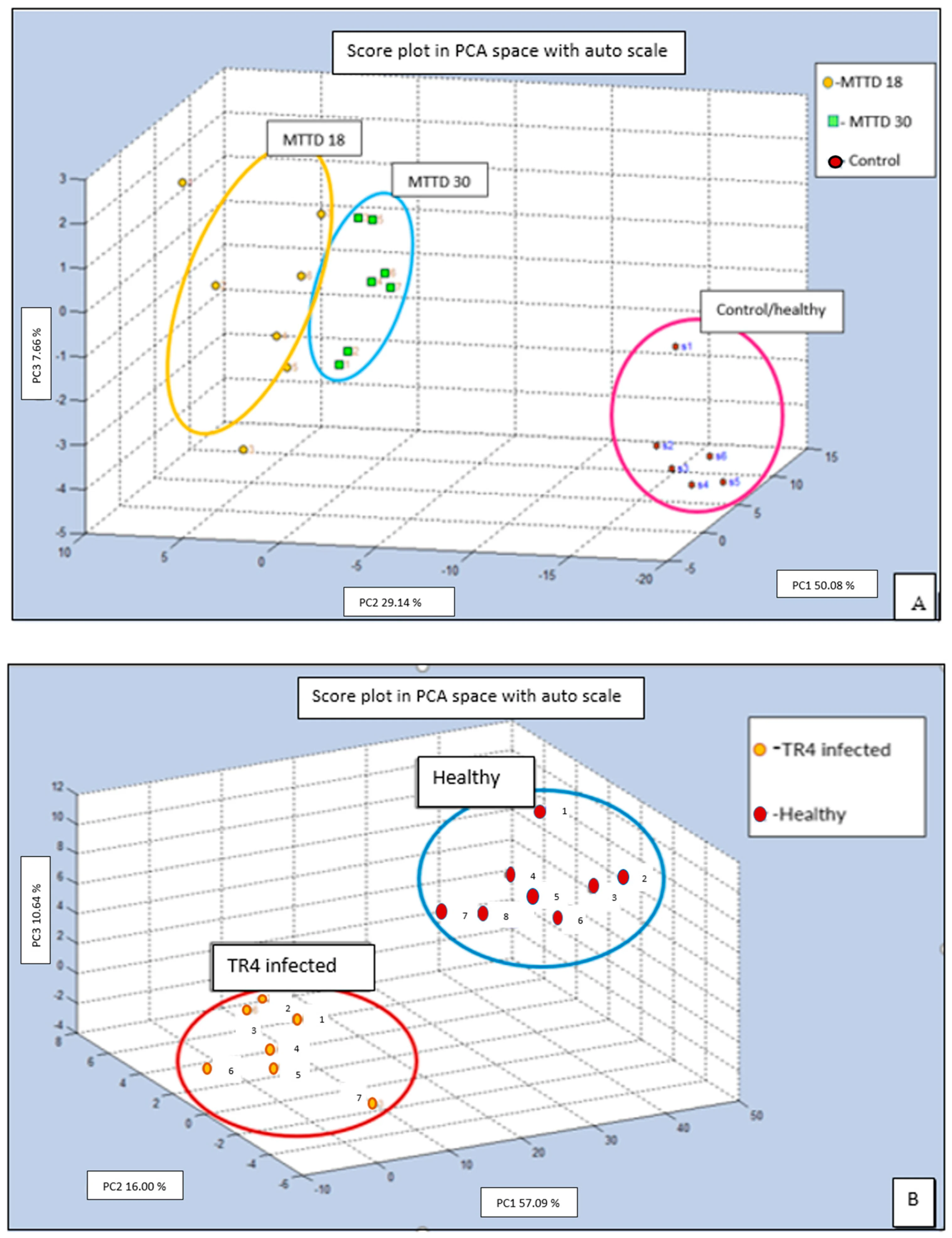
Figure 10. PCA plot for MSEM 160 (A) MTTD 18, MTTD 30 and control/healthy mango leaves, (B) TR4 infected and healthy banana pseudo-stems.

