微信公众号


Deependra Kumar Ban et al. https://doi.org/10.1002/adma.74079
ABSTRACT
Insect olfactory receptors have evolved to detect a wide range of chemicals and biomolecules, offering a promising foundation for next‐generation chemical sensors. We report the first direct integration of the odorant receptor MhOR5 from Machilis hrabei onto a graphene field‐effect transistor (gFET) for selective, label‐free detection of small organic compounds (SOCs). Large scale production of MhOR5 was achieved for the first time, yielding a stable tetrameric protein (80% purity) with up to 3‐month stability. High‐quality gFETs were fabricated at the wafer scale and quality controlled before utilization, demonstrating highly reproducible chips. The MhOR5‐functionalized gFETs were tested against sixteen chemically diverse SOCs, including eugenol, DEET, hexanol, and octanol, across a concentration range of 200 nm to 10 mm. Each analyte induced a concentration‐dependent response in the sensor. Binding analysis within the tested SOCs revealed the strongest affinity for acetophenone (logKD = 0.28), and the weakest for sulcatone (logKD = 4.4). Notably, the sensor distinguished eugenol from its structural isomer, isoeugenol, an achievement difficult to detect using conventional sensors. This work establishes a modular biosensing platform that couples the molecular selectivity of insect olfactory receptors with the exceptional sensitivity of graphene‐based sensors. The MhOR5‐gFET biosensor demonstrates significant potential for applications in biotechnology, diagnostics, and biosurveillance.
昆虫的嗅觉受体在进化过程中形成了检测多种化学物质和生物分子的能力,这为下一代化学传感器提供了极具前景的基础。我们在此报告了首次将来自 Machilis hrabei(一种古昆虫)的气味受体 MhOR5 直接集成到石墨烯场效应晶体管(gFET)上,用于对小分子有机化合物(SOCs)进行选择性、免标记的检测。我们首次实现了 MhOR5 的大规模生产,获得了一种稳定的四聚体蛋白(纯度达80%),其稳定性长达 3 个月。我们在晶圆尺度上制造了高质量的 gFET,并在使用前进行了质量控制,展示了高度可重复的芯片性能。我们将 MhOR5 功能化的 gFET 对 16 种化学性质各异的 SOCs 进行了测试,包括丁香酚、避蚊胺(DEET)、己醇和辛醇,浓度范围覆盖 200 nM 到 10 mM。每种分析物都诱导传感器产生了浓度依赖性的响应。在测试的 SOCs 中,结合分析显示其对苯乙酮的亲和力最强(logKD = 0.28),而对 sulcatone(一种酮类化合物)的亲和力最弱(logKD = 4.4)。值得注意的是,该传感器能够区分丁香酚及其结构异构体异丁香酚,这是传统传感器难以实现的成就。这项工作建立了一个模块化的生物传感平台,将昆虫嗅觉受体的分子选择性与石墨烯基传感器的卓越灵敏度相结合。MhOR5-gFET 生物传感器在生物技术、诊断和生物监测领域的应用中展现了巨大的潜力。
Keywords: field effect transistor, graphene, MhOR5, small organic compounds, synthetic biology
关键词: 场效应晶体管,石墨烯,MhOR5,小分子有机化合物,合成生物学
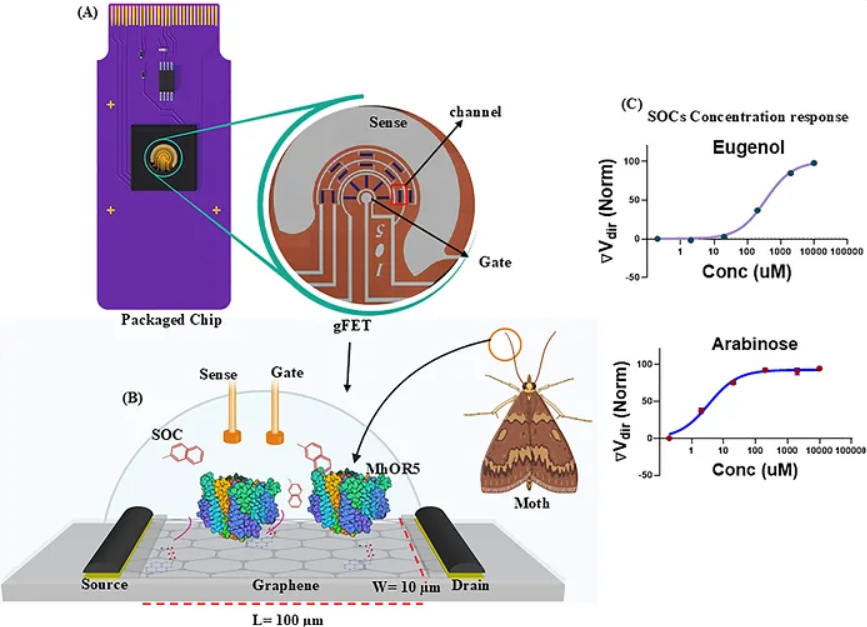
Illustration of the overall sensing concept and system architecture presented in this work. (A) Image of the packaged chip and magnified view of the sensing region showing the device architecture, including coplanar gate and sense electrodes and an array of fifteen graphene channels (100 × 10 µm each). During measurement, the gate electrode was used to apply the gate‐potential sweep through the liquid, while the sense electrode was used to monitor the liquid‐gate potential and help maintain stable gating. The gate electrode applies the liquid‐gate potential through the electrolyte, while the sense electrode monitors the local electrolyte potential during measurement to ensure stable and reproducible gating conditions across the graphene channels. (B) Expanded schematic of the gFET sensor architecture highlighting the source and drain electrodes, graphene channel, gate and sense electrodes, and MhOR5 olfactory receptors from Machilis hrabei immobilized on the graphene surface. Ligand binding events at the receptor‐functionalized graphene interface modulate the local electrostatic environment, resulting in measurable changes in the Dirac voltage. (C) Representative concentration‐dependent response profiles for SOCs including eugenol and arabinose measured using the MhOR5‐integrated gFET sensor.
(A) 封装芯片的图像及传感区域的放大视图,展示了器件架构,包括共面栅极和传感电极,以及由 15 个石墨烯通道(每个 100 × 10 µm)组成的阵列。在测量过程中,栅极电极用于通过液体施加栅极电位扫描,而传感电极用于监测液体栅极电位并帮助维持稳定的栅控状态。栅极电极通过电解质施加液体栅极电位,而传感电极在测量期间监测局部电解质电位,以确保石墨烯通道间稳定且可重复的栅控条件。(B) gFET 传感器架构的扩展示意图,重点展示了源极和漏极、石墨烯通道、栅极和传感电极,以及固定在石墨烯表面的来自 Machilis hrabei 的 MhOR5 嗅觉受体。受体功能化石墨烯界面处的配体结合事件会调节局部静电环境,从而导致狄拉克电压(Dirac voltage)的可测量变化。(C) 使用 MhOR5 集成 gFET 传感器测量的 SOCs(包括丁香酚和阿拉伯糖)的代表性浓度依赖性响应曲线。