微信公众号


Reduced dopaminergic reinforcement, not learning capacity, limits operant learning in aging Drosophila
Ishrat Jahan et al.
Abstract
Aging is associated with a progressive decline in cognitive function, including the ability to adapt behavior based on its consequences. While classical conditioning in Drosophila melanogaster has provided key insights into reinforcement learning, how aging impacts operant learning and adjusting behavior based on action outcomes remains unclear. Here, we used a closed-loop optogenetic paradigm to test how aging affects operant learning and the role of dopaminergic neurons (DANs; PPL1 and PAM) in this process. Activation of distinct DAN subsets revealed that both young and aged flies retain PPL1-dependent avoidance learning, indicating preserved action–outcome learning with age. However, learning in aged flies depended on prolonged reinforcement: unlike young flies, they failed to learn under shorter optogenetic stimulation durations, suggesting an aging-associated reduced dopaminergic reinforcement rather than a loss of learning capacity. Moreover, reducing mitochondrial antioxidant capacity via SOD2 knockdown in PPL1 neurons phenocopied the aging-related deficit, implicating oxidative stress in impaired reinforcement signaling. In contrast, broad PAM neuron activation drove robust learning across ages and stimulation regimes. Nevertheless, functional dissection of PAM subpopulations revealed subtype-specific aging-associated vulnerability within dopaminergic circuits. In line with the behavioral data, PPL1 but not PAM neurons exhibited age-dependent reductions in cell size. Together, our findings suggest that aging selectively reduces dopaminergic reinforcement in a DAN subtype-dependent manner while preserving the capacity for operant learning. Increasing reinforcement length rescues this deficit, indicating that altered dopaminergic signaling, rather than impaired learning capacity, is a key driver of age-related cognitive decline.
摘要
衰老与认知功能的进行性衰退相关,其中包括根据行为结果调整行为的能力。尽管黑腹果蝇(Drosophila melanogaster)的经典条件化学习为强化学习提供了关键见解,但衰老如何影响操作性学习以及基于行动结果调整行为,目前尚不清楚。本研究采用闭环光遗传学范式,探究衰老如何影响操作性学习,以及多巴胺能神经元(DANs;PPL1和PAM)在此过程中的作用。激活不同的DAN亚群显示,年轻和衰老果蝇均保留了PPL1依赖性回避学习,表明行动-结果学习随年龄增长得以保持。然而,衰老果蝇的学习依赖于延长的强化刺激:与年轻果蝇不同,它们在较短的光遗传刺激时长下无法学习,提示衰老相关的多巴胺能强化减弱,而非学习能力的丧失。此外,通过PPL1神经元中的SOD2敲低降低线粒体抗氧化能力,可模拟出衰老相关的缺陷,表明氧化应激参与了强化信号受损。相比之下,广泛激活PAM神经元在两种年龄和所有刺激模式下均能驱动稳健的学习。尽管如此,对PAM亚群的功能解析揭示了多巴胺能环路中存在亚型特异性的衰老相关脆弱性。与行为数据一致的是,PPL1神经元(而非PAM神经元)表现出年龄依赖性的细胞大小减小。综上,我们的研究结果表明,衰老以DAN亚型依赖性方式选择性地减少多巴胺能强化,同时保留操作性学习能力。延长强化时长可挽救这一缺陷,提示改变的多巴胺能信号传导,而非学习能力受损,是年龄相关认知衰退的关键驱动因素。
···
Materials and Methods材料与方法
flyPAD feeding assay flyPAD摄食监测
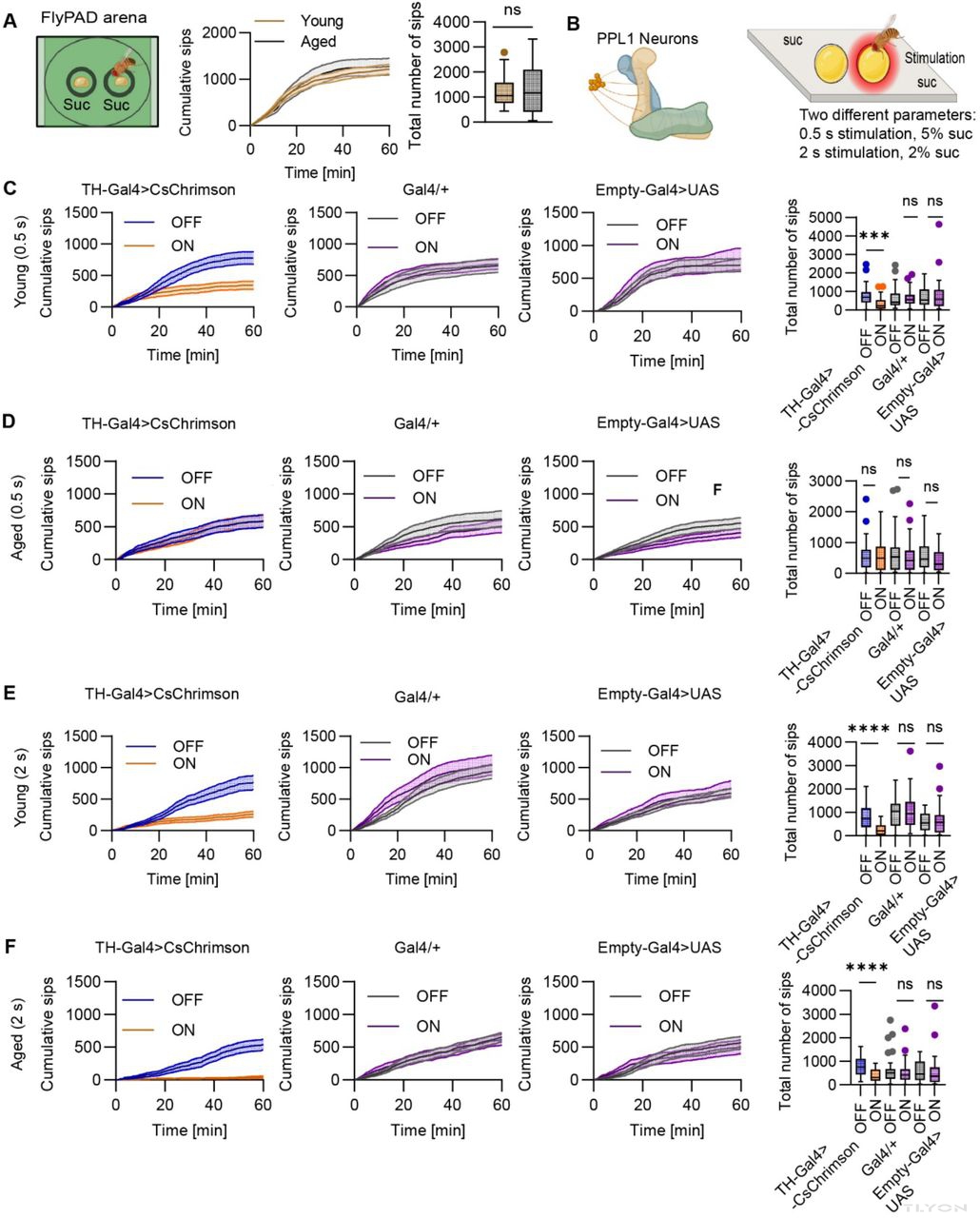
flyPAD experiments were conducted as described previously (Itskov et al., 2014). Flies were starved as described above prior to behavioral experiments. Individual flies were transferred by aspiration into a behavioral arena containing two food wells connected to independent electrodes. Each well contained 1% agarose (low-gelling-temperature, A9414, Sigma-Aldrich) supplemented with 5% sucrose. Experiments were performed in a climate-controlled chamber at 25°C and 60% humidity. Following transfer into the behavioral arena, feeding behavior was recorded for a fixed duration of 1 h. Capacitance signals were analyzed using a custom MATLAB script described previously. Individual feeding events (sips) were identified from capacitance changes, and feeding behavior was quantified by calculating the cumulative and total number of sips detected across the two electrodes. The same experimental procedure was used for both young and aged flies.
flyPAD实验按照先前描述的方法进行(Itskov等,2014)。实验前按上述方法对果蝇进行饥饿处理。通过吸气将单只果蝇转移至行为测试舱中,舱内含有两个连接独立电极的食物孔。每个孔中装有含1%琼脂糖(低凝胶温度,A9414,Sigma-Aldrich)和5%蔗糖的基质。实验在25°C、60%湿度的气候控制室中进行。将果蝇转移至行为测试舱后,记录摄食行为,固定时长为1小时。使用先前描述的定制MATLAB脚本分析电容信号。通过电容变化识别单次摄食事件(啜饮),并计算两个电极上检测到的累积和总摄食次数来量化摄食行为。年轻和衰老果蝇均采用相同的实验步骤。
optoPAD feeding assay optoPAD摄食测定
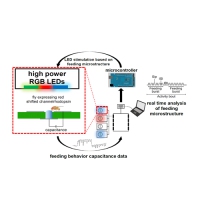
optoPAD experiments were conducted using the optoPAD system as previously described (Itskov et al., 2014; Moreira et al., 2019). Individual flies were transferred by aspiration into a behavioral arena containing two food wells connected to independent electrodes. Flies were offered 5% sucrose supplemented with 1% agarose (low-gelling-temperature agarose, A9414, Sigma-Aldrich). 2.5 µL of the sucrose–agarose substrate was loaded into each well prior to the start of the experiment. For closed-loop optogenetic experiments, the flyPAD system was integrated with the optoPAD platform, allowing interaction events on the designated light-paired food source to trigger red-light stimulation in real time. One food source was paired with red LED illumination (2.5 V, 625 nm); LED activation occurred upon contact with the light-paired food and remained active for a fixed duration independent of subsequent fly behavior. The light-paired food source was pseudo-randomly assigned across experiments to balance left and right positions.
optoPAD实验使用先前描述的optoPAD系统进行(Itskov等,2014;Moreira等,2019)。通过吸气将单只果蝇转移至行为测试舱中,舱内含有两个连接独立电极的食物孔。果蝇被提供含5%蔗糖和1%琼脂糖(低凝胶温度琼脂糖,A9414,Sigma-Aldrich)的基质。实验开始前,每个孔中装入2.5 µL蔗糖-琼脂糖基质。在闭环光遗传学实验中,flyPAD系统与optoPAD平台整合,使得果蝇与指定光配对食物源的接触行为可实时触发红光刺激。其中一个食物源与红色LED照明(2.5 V,625 nm)配对;LED在果蝇接触光配对食物时激活,并在固定时长内保持开启,不依赖于后续行为。光配对食物源在实验中以伪随机方式分配,以平衡左右位置。