微信公众号


La Jolla Virus: The Pathology and Transmission in Its Host Drosophila suzukii
Ibrahim Abdelhafiz et al.
Abstract
Drosophila suzukii, commonly known as spotted-wing drosophila, has emerged as a highly destructive pest in global fruit and wine production. The effectiveness of chemical control is significantly compromised by rapid resistance development and a limited range of insecticide options. Biological control presents a promising sustainable alternative. Our previous work suggested the La Jolla Virus (LJV) as a suitable candidate for the development of an insect virus-based control option. Here, we characterized the natural transmission and pathology of the virus. We tested various modes of horizontal transmission, including airborne, venereal and oral, and fecal routes. To understand LJV pathology in infected flies, we studied feeding behavior and demonstrated changes in food absorption compared to non-infected flies. We also investigated the impact on fecundity and egg-to-adult success rate. Altogether, these results collectively improve our understanding of LJV transmission in natural populations and the implication of infected flies in food ingestion and overall fitness.
铃木氏果蝇(Drosophila suzukii),俗称斑翅果蝇,已成为全球水果和葡萄酒产业中极具破坏性的害虫。化学防治手段因抗药性快速发展及可用杀虫剂种类有限而效果大幅受限。生物防治作为一种可持续的替代方案展现出广阔前景。我们前期研究提示拉霍亚病毒(La Jolla Virus, LJV)具备开发为昆虫病毒防控制剂的潜力。本研究系统解析了该病毒的自然传播途径与致病机制:通过空气、性接触、口服及粪便等多重水平传播途径的实验验证;在病理学研究方面,通过观测染毒果蝇的取食行为,揭示了其与健康果蝇相比食物吸收效率的改变;同时深入探讨了病毒感染对雌虫繁殖力及卵至成虫发育成功率的影响。这些发现共同深化了我们对LJV在自然种群中传播规律的认识,揭示了染毒果蝇在食物摄取及种群适合度方面的生物学变化。
Keywords: Drosophila suzukii; biological pest control; La Jolla virus; iflavirus; transmission; food intake
关键词:铃木氏果蝇;害虫生物防治;拉霍亚病毒;类浮丝病毒;传播途径;食物摄取
···
2.5. The Feeding Behavior of Infected Flies
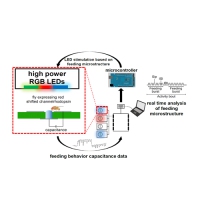
To assess the impact of viral infection on feeding behavior, we employed the flyPAD (fly Proboscis and Activity Detector) system, an automated high-resolution behavioral monitoring tool that uses capacitive sensors to detect and analyze feeding behavior in Drosophila [24]. The flyPAD system allows for the extraction of various feeding metrics, including the number of activity bouts, the total duration of activity bouts, and the number of sips, all of which correlate with food intake. The system’s sensitivity enables the estimation of the volume of food consumed per sip, providing a comprehensive view of feeding dynamics in individual flies.
为评估病毒感染对取食行为的影响,我们采用flyPAD(果蝇进食活动检测)系统——一种通过电容传感器检测并分析果蝇进食行为的自动化高分辨率行为监测工具[24]。该体系可提取包括活动频次、活动总时长及单次吸食次数等多个与食物摄入量相关的进食指标。凭借其高灵敏度,该系统还能估算单次吸食的食物体积,为个体果蝇的进食动态特征提供全面解析。
We adopted a slightly modified protocol based on previous work [24] The experiment consisted of three runs each for females and males, comparing 24 La Jolla Virus (LJV)-infected flies to 24 uninfected control flies per run. Prior to the experiment, flies were wet starved (females for 24 h and males for 18 h) to standardize hunger levels. Individual flies were then placed in the feeding arena of the flyPAD system. For each assay, we added 4 µL of either 5 mM or 50 mM sucrose solution to the reading electrode. Flies were allowed to feed for 1 h, during which their interactions with the food were continuously monitored by the flyPAD system. The system recorded multiple behavioral metrics, including the number of activity bouts (approaches to food), the total duration of activity bouts, and the number of sips. These parameters were used to estimate food intake and analyze feeding dynamics.
我们在前人研究[24]基础上略加改良实验方案。实验分为三组重复,分别对雌雄果蝇进行测试,每组将24只拉霍亚病毒(LJV)感染的果蝇与24只未感染对照果蝇进行比对。实验前对果蝇实施湿式禁食(雌蝇24小时,雄蝇18小时)以标准化饥饿程度。随后将单个果蝇放置于flyPAD系统的摄食观测区中。每次检测时,我们在读取电极上滴加4ul ,5mmol或50mmol的蔗糖溶液。让果蝇自由取食1小时,在此期间flyPAD系统持续监测其与食物的互动行为。系统记录的多项行为指标包括:活动频次(接近食物次数)、活动总时长及吮吸次数,这些参数用于估算食物摄入量并分析摄食动态特征。