 微信公众号


Ovary-Derived Signals Align Protein Appetite with Oogenesis
R. R. Nóbrega et al.
Abstract
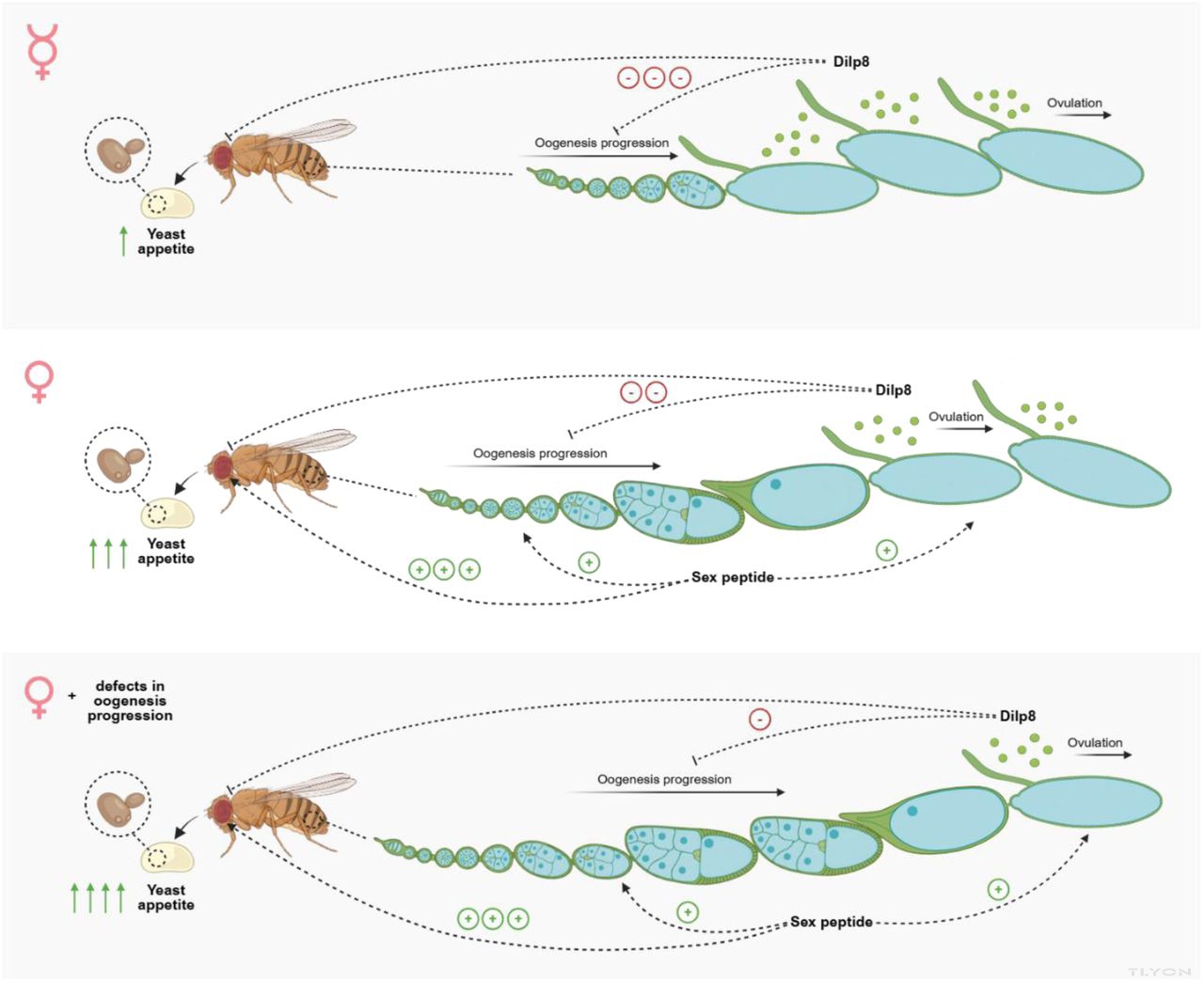
Maintaining organismal homeostasis requires mechanisms that coordinate the metabolic needs of individual organs with whole animal nutrient intake. Although nutrient sensors and central pathways regulating hunger have been extensively characterized, how peripheral organ physiology influences nutrient specific appetites remains poorly understood. Here, we identify a previously unrecognized signalling axis, originated in the ovary, that modulates yeast appetite in Drosophila melanogaster. Through a targeted germline RNAi screen, we find that specific perturbations in oogenesis consistently and selectively increase yeast appetite. The manipulations increasing yeast appetite disrupt oogenesis progression, producing a shared signature of increased vitellogenic follicle accumulation and reduced number of mature (stage14) oocytes. This shift is accompanied by decreased expression of the relaxin-like hormone Dilp8, and loss of Dilp8 recapitulates the feeding phenotype. We show that this ovarian regulation of nutrient specific appetite is independent of amino acid state but requires mating, indicating integration with Sex Peptide–mediated reproductive activation. Together, our findings uncover a novel mechanism that couples oogenesis progression to nutrient selection, emphasizing the importance of the ovary as an active regulator of whole organism nutritional decisions. This work provides a conceptual framework for how reproductive tissues communicate their physiological demands to other organs and raises the possibility that analogous ovary-derived signals may shape nutrient specific appetite and metabolic states in other animals.
维持机体稳态需要协调各器官代谢需求与整体动物营养摄入的机制。尽管营养感知通路和调节饥饿的中枢机制已被广泛研究,但外周器官生理状态如何影响营养特异性食欲仍不清楚。本研究在黑腹果蝇中发现了一条源于卵巢的、此前未知的信号轴,该轴能够调节果蝇对酵母的食欲。通过靶向生殖系的RNAi筛选,我们发现卵子发生过程中的特定扰动会一致且选择性地增强酵母食欲。这些增强酵母食欲的操作会阻碍卵子发生进程,产生共同的表型特征:卵黄发生期卵泡积累增加,而成熟(第14期)卵母细胞数量减少。这种变化伴随松弛素样激素Dilp8的表达下降,而敲除Dilp8可重现上述摄食表型。我们进一步证明,卵巢对营养特异性食欲的这种调节独立于氨基酸状态,但需要交配行为,提示其与性肽介导的生殖激活信号整合。综上,我们的发现揭示了一种将卵子发生进程与营养选择相耦合的新机制,强调了卵巢作为机体整体营养决策主动调节器的重要性。该工作为理解生殖组织如何将其生理需求传递给其他器官提供了概念框架,并提示其他动物中可能存在类似的卵巢来源信号,从而调控营养特异性食欲和代谢状态。
···
Fly Proboscis Activity Detector (flyPAD) assays
flyPAD assays were performed as described by Itskov and colleagues35. Single flies were tested in arenas that contained two food patches: 10% yeast and 20mM sucrose each mixed with 1% agarose. Flies were individually transferred to flyPAD arenas by mouth aspiration and allowed to feed for 1h at 25 °C and 70% relative humidity. The total number of sips per animal during the assay and other feeding parameters were calculated using previously described algorithms35. Flies that did not eat (defined as having fewer than two activity bouts during the assay) were excluded from the analysis.


