微信公众号


From perception to valence: a pair of interneurons that assign positive valence to sweet sensation in Drosophila
Kevin William Christie et al.
Summary
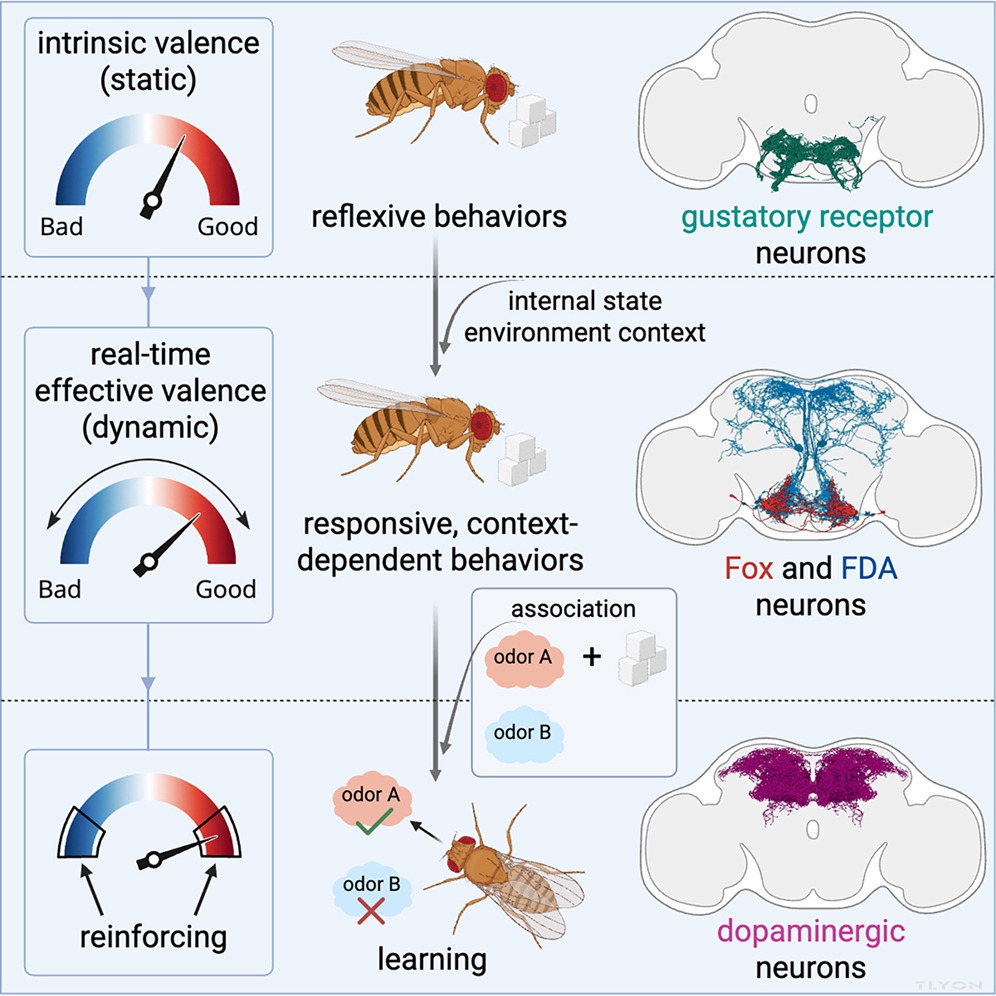
Assigning valence—appeal or aversion—to gustatory stimuli and relaying it to higher-order brain regions to guide flexible behaviors is crucial to survival. Yet the neural circuit that transforms gustatory input into motivationally relevant signals remains poorly defined in any model system. In Drosophila melanogaster, substantial progress has been made in mapping the sensorimotor pathway for feeding and the architecture of the dopaminergic reinforcement system. However, where and how valence is first assigned to a taste has long been a mystery. Here, we identified a pair of subesophageal zone interneurons in Drosophila, termed fox, that impart positive valence to sweet taste and convey this signal to the mushroom body, the fly’s associative learning center. We show that fox neuron activity is necessary and sufficient to drive appetitive behaviors and can override a tastant’s intrinsic valence without impairing taste quality discrimination. Furthermore, fox neurons transmit the positive valence to specific dopaminergic neurons that mediate appetitive memory formation. Our findings reveal a circuit mechanism that transforms sweet sensation into a reinforcing signal to support learned sugar responses. The fox neurons exhibit a convergent–divergent “hourglass” circuit motif, acting as a bottleneck for valence assignment and distributing motivational signals to higher-order centers. This architecture confers both robustness and flexibility in reward processing—an organizational principle that may generalize across species.
摘要
将效价(吸引力或厌恶感)赋予味觉刺激,并将其传递至高级脑区以指导灵活行为,对生存至关重要。然而,在任何模式生物中,将味觉输入转化为动机相关信号的神经回路仍不明确。在黑腹果蝇中,关于摄食的感觉运动通路和多巴胺能强化系统的结构已取得显著进展,但味觉效价最初在何处以及如何被赋予,长期悬而未决。本研究在果蝇中发现了一对位于食道下区的中枢神经元(称为fox神经元),它们能够赋予甜味以积极效价,并将此信号传递至果蝇的学习中枢——蘑菇体。我们证明,fox神经元的活性对于驱动食欲行为既是必要的,也是充分的,且能在不影响味觉质量分辨能力的前提下,逆转味刺激的内在效价。此外,fox神经元将积极效价传递给特定的多巴胺能神经元,这些神经元介导食欲记忆的形成。我们的研究揭示了一种将甜味感知转化为强化信号以支持习得性糖反应的回路机制。fox神经元呈现出一种"沙漏"状的会聚-发散回路模式,充当效价分配的瓶颈,并将动机信号分配至高级中枢。这种结构赋予了奖赏处理过程的稳健性与灵活性——这一组织原则可能在不同物种间具有普适性。
···
Behavioral assays
Positional preference assays were performed at 25°C, 50%-60% relative humidity in darkness. Female flies (3-7d old) were loaded into rectangular chambers, 8 flies per chamber. After a 2-min baseline period, one side of the chamber (selected at random) was illuminated by 0.5 Hz 1-second pulsed 625-nm red LED, at 40% intensity (100% intensity = 3.9 mW/cm^2) for 3 min. Following the illumination period, there was a 2-min recovery period. Experiments were recorded with infrared cameras (BlackFly USB3 camera, Teledyne vision solutions). The frequencies and intensities of LED stimulation were controlled using MATLAB (MathWorks, Inc.). Acquired video was analyzed with custom MATLAB scripts that detected the position of the flies, allowing for the calculation of a Preference Index as described in Shao et al. 2017.
行为学检测方法
位置偏好检测 在25℃、相对湿度50%-60%的黑暗环境中进行。将雌性果蝇(3-7日龄)装入矩形行为室,每室8只。经过2分钟基线期后,随机选择行为室一侧,使用波长为625纳米、强度为40%(100%强度对应3.9 mW/cm²)的红色LED,以0.5赫兹频率(每次脉冲持续1秒)照射3分钟。照射结束后,设置2分钟恢复期。实验过程通过红外摄像机(BlackFly USB3,Teledyne vision solutions)记录。LED的刺激频率与强度由MATLAB(MathWorks, Inc.)控制。采集的视频通过定制MATLAB脚本分析,该脚本可检测果蝇位置,并据此计算偏好指数(计算方法参照Shao等人2017年文献)。
Associative learning with optogenetic stimulation was conducted in a circular arena that couples optogenetic stimulation with an odor delivery system, as described in Aso et al., 2014. All tests were performed at 25°C, 50%-60% relative humidity. The olfactory cues used were 4-methyl-cyclohexanol (1:1000) and 3-octanol (1:1000). Optogenetic stimulation used a 0.5 Hz 625-nm LED light at 40% or 10% intensities (100% intensity = 3.9 mW/cm^2). Flies were trained as groups of 12-14 individuals using a single training session consisting of 1-min exposure to air, followed by a 1-min exposure to odor A paired with neuronal activation/silencing, followed by a 1-min exposure to air, and finally a 1-min exposure to odor B. Memory was tested 1 min after training, during which the odors A and B were delivered to each pair of opposing quadrants. Experiments were recorded under IR illumination with a camera (Point Gray Research) located above the chamber and equipped with an IR long-pass filter. The subsequent video was analyzed with custom MATLAB scripts that detect the position of flies within the chamber.
光遗传联合学习实验 在圆形竞技场中进行,该装置集成了光遗传刺激与气味递送系统(方法参照Aso等人,2014)。所有测试均在25℃、相对湿度50%-60%下进行。使用的气味线索为4-甲基环己醇(1:1000稀释)和3-辛醇(1:1000稀释)。光遗传刺激采用波长为625纳米的LED光,以0.5赫兹频率、40%或10%强度(100%强度对应3.9 mW/cm²)进行。果蝇以每组12-14只进行训练,单次训练程序包括:1分钟空气暴露、1分钟气味A暴露(同时进行神经元激活/抑制)、1分钟空气暴露、1分钟气味B暴露。训练结束1分钟后进行记忆测试,测试时气味A和B分别被递送至竞技场中两对相对的象限。实验在红外照明下,通过装有红外长通滤光片、置于行为室上方的摄像机(Point Gray Research)记录。后续视频分析采用定制MATLAB脚本,以检测果蝇在行为室内的位置。
To quantify 24-hour feeding behavior, we used an assay generally based on the ‘Con-Ex’ protocol described by Shell et al., 2018. Dyed food was prepared via the addition of FD&C blue No. 1 dye to normal fly food with a concentration of 1% (wt/vol). A small volume of dyed food (100 μL) was pipetted into the underside of a 2.0 mL Eppendorf tube cap 30 min prior to adding flies. Two holes were poked near the top of the vials using a heated needle, allowing air/moisture circulation. Two 3- to 7-days-old mated female flies were transferred and allowed to feed ad libitum in the vials for 24 h at 25℃ (55% humidity). After feeding, vials were placed on dry ice to euthanize the flies, which were then transferred to a 1.7 mL Eppendorf tube. Fly carcasses were ground in 300 μL of distilled water and centrifuged. A portion of supernatant (100 μL) was transferred to a 96-well culture plate. Concurrently, the excreta in the feeding vial were dissolved in 500 μL of distilled water, vortexed for 5-10 s, and 100 μL of the sample transferred to the same 96-well culture plate. Using a plate reader, the absorbance values of the samples (λ = 620 nm) were measured and converted to concentrations via standard curves, then converted to usable mass for data analysis.
24小时摄食行为量化实验主要基于Shell等人(2018年)描述的"Con-Ex"方案。染色食物通过在常规果蝇食物中添加1%(重量/体积)浓度的FD&C蓝色1号染料制备。在加入果蝇前30分钟,将少量染色食物(100微升)滴加至2.0毫升Eppendorf管盖内侧面。使用加热针头在管壁靠近顶部处戳两个小孔,以利于空气/水分流通。将两只3-7日龄已交配的雌性果蝇转入管中,在25℃(湿度55%)条件下自由摄食24小时。摄食结束后,将管置于干冰上麻醉果蝇,随后将其转移至1.7毫升Eppendorf管中。将果蝇样本在300微升蒸馏水中研磨并离心。取部分上清液(100微升)转移至96孔培养板。同时,将摄食管内的排泄物溶解于500微升蒸馏水中,涡旋振荡5-10秒,取100微升样品转移至同一96孔板。使用酶标仪测量样品吸光度(波长λ = 620纳米),通过标准曲线转换为浓度值,并进一步转换为可分析的质量数据用于后续数据处理。
Acute feeding behavior was quantified by use of the FlyPad behavioral monitoring system (Itskov et al. 2014), at 25°C, 50% -60% relative humidity. Warmed liquified media was loaded into both probes in each FlyPAD chamber in darkness. Individual female flies (3-7 d old) were placed in each FlyPAD chamber. Flies were allowed to feed ad libitum for 50 min total. In the open-loop feeding and choice assay, the FlyPAD chambers were illuminated with 625-nm red LEDs to optogenetically stimulate channelrhodopsin-expressing neurons. In the closed-loop feeding assay, the FlyPAD chambers were only illuminated with red LED when flies fed on one of the two probes in each arena. The probe associated with illumination was alternated for the next set of experiments to mitigate potential probe-specific bias. Media containing 7% yeast, 160 mM sucrose, and 0.7% agar was used for open-loop feeding assay. Media containing either 0.7% agar (neutral taste), 100 mM sucrose (sweet taste), or 0.5 mM quinine (bitter taste) were used for open-loop choice assays and closed-loop feeding assays. Analysis of feeding behavior used custom MATLAB scripts that extracted the total number of sips during the feeding period.
急性摄食行为量化 使用FlyPad行为监测系统(Itskov等人,2014年),在25℃、相对湿度50%-60%下进行。在黑暗环境中,将预热液化的培养基加载至每个FlyPAD进食室的两个探头中。将单只雌性果蝇(3-7日龄)置于各FlyPAD行为室中,允许其自由摄食总计50分钟。在开环摄食和选择实验中,FlyPAD行为室使用625纳米红色LED照明,以光遗传学方式刺激表达通道视紫红质的神经元。在闭环摄食实验中,仅当果蝇在竞技场内两个探头中的某一个上取食时,FlyPAD行为室才以红色LED照明。与照明相关联的探头在下一组实验中交替使用,以减少潜在的探头特异性偏差。开环摄食实验使用含7%酵母、160毫摩尔蔗糖和0.7%琼脂的培养基。开环选择实验和闭环摄食实验则分别使用含0.7%琼脂(中性味觉)、100毫摩尔蔗糖(甜味)或0.5毫摩尔奎宁(苦味)的培养基。摄食行为分析采用定制MATLAB脚本,提取摄食期间的总啜饮次数。
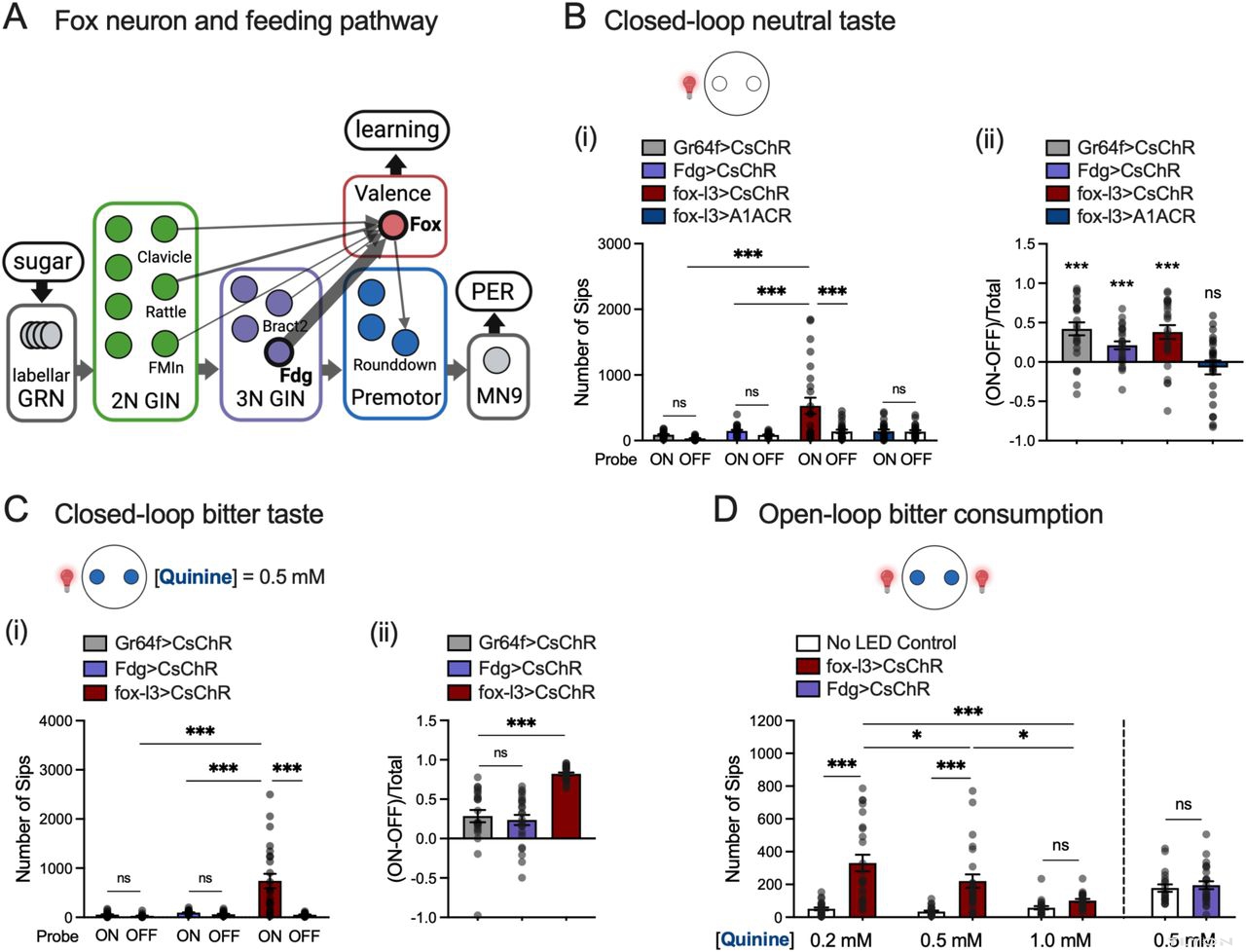
Figure 2.
Activation of fox neurons overrides the intrinsic valence of neutral and aversive taste. A. Illustration of fox neural connections with the neural pathways regulating proboscis extension reflex (PER). Synapses from Fdg neurons comprise 10% of the synaptic inputs to fox neurons. B. Optogenetic activation of either Gr64f-expressing GRNs (Gr64f>CsChR), Fdg neurons (Fdg>CsChR), or fox neurons (fox-l3>CsChR) when the fly is feeding on one of the two probes containing agar significantly increased fly’s feeding from the associated probe, whereas optogenetic silencing of fox neurons (fox-l3>A1ACR) with a probe did not change the fly’s choice. Panel (i) shows the number of sips on each probe. One-way ANOVA with Tukey’s multiple comparison test, ns. p>0.05; *** p<0.001. Panel (ii) shows preference, calculated as the difference between sips on associated versus non-associated probe, normalized by the total number of sips ((ON-OFF)/Total). One sample t test (hypothetical value = 0), *** p<0.001, ns p>0.05. N = 24 flies for each group. C. Flies’ feeding from one of the two probes containing quinine (0.5 mM) was significantly in-creased when the probe was associated with fox activation (fox-l3> CsChrimson), but not with Gr64f-expressing GRN (Gr64f> CsChrimson) or with Fdg neuron (Fdg> CsChrimson) activation. Panel (i) shows the number of sips on each probe. One-way ANOVA with Tukey’s multiple comparison test, ns. p>0.05; *** p<0.001. Panel (ii) shows preference, calculated as the difference between sips on associated versus non-associated probe, normalized by the total number of sips ((ON-OFF)/Total). One-way ANOVA with Tukey’s multiple comparison test, *** p<0.001, ns. p>0.05. N = 24 flies for each group. D. Activating fox neurons (fox-l3>CsChrimson) significantly increased flies’ consumption of agar containing 0.2 mM and 0.5 mM quinine but did not promote consumption for agar containing 1.0 mM quinine. N=24 for each group. One-way ANOVA with Tukey’s multiple comparison test, ns. p>0.05, * p<0.05, ** p<0.01, *** p<0.001. In contrast, activating Fdg neurons (Fdg>CsChrimson) did not increase the consumption of quinine (0.5 mM). N = 24 flies for each group. t test, ns. p>0.05.